Top 2025 Tips for Optimal Dental Billing Efficiency with Qiaben Health
In this wild world of dentistry today, billing is no longer something done after hours—rather, it’s a mission-critical operation that affects every area of your practice, from cash flow to patient satisfaction. With the advancements in AI technology, real-time insurance verification, and more regulative payer rules, effective dental billing can no longer be relegated to antiquated systems or backlogged front-desk staff.
At Qiaben Health, we’ve seen firsthand how practices that modernize their billing strategies are collecting more, reducing stress, and scaling faster. This in-depth guide explores over 2,000 words of practical strategies, tips, and tools to help your dental practice streamline billing in 2025.
The New Rules of Dental Billing in 2025
Those were the times when dental clinics relied on memory, paper EOBs, or calls to insurers. In 2025, shrewd dental offices look to a data-driven, technology-enabled system of billing effectiveness. And here’s the way things have turned around:
- AI takes the lead in claim scrubbing, denial forecasting, and coding optimization.
- Patients anticipate transparency in costs, insurance coverage, and payment responsibilities.
- Payers are more powerful than ever, regularly revising coverage guidelines and demanding accurate documentation.
- Cybersecurity and HIPAA compliance is not an option.
That does not say anything about your billing system needing to comply—or forgo thousands in missed revenue.
1. Harness AI-Driven Billing Solution
Artificial intelligence is revolutionizing the way in which dental billing staff work through claims and avoid denials. Savvy offices are capitalizing on solutions that:
- Detect missing documentation or incorrect CDT codes automatically.
- Offer greater-acceptance code recommendations.
- Detect high-risk claims prior to filing
Note: Jarvis AI and Pearl AI can read clinical notes, radiographs, and CDT codes for greatest reimbursement likelihood. Such programs help minimize human error and cut denial rates considerably.
Tip: If your billing software does not have AI capabilities, consider adding third-party products or outsourcing to a service like Qiaben Health, which already utilizes AI-driven systems.
2. Conduct Real-Time Insurance Verification
Insurance benefits verification prior to a patient visit is no longer optional—it’s
mandatory. Patients need to know their co-pays, deductibles, and what their
insurance does or doesn’t cover prior to any treatment.
Utilize real-time verification solutions that are integrated with your practice management system (PMS), for example:
- Vyne Dental.
- DentalXChange.
- Weave, Curve, or Open Dental with integrated eligibility modules
Best Practice: Confirm coverage 48 hours prior to visit, indicate discrepancies, and treat patients openly. This prevents surprise billing and increases patient confidence.
3. Emphasize CDT Code Accuracy and Updating
CDT codes are revised annually by the ADA—and utilizing old codes is one of the quickest methods of accumulating denials. In 2025, dental clinics should:
- Maintain awareness of year-to-year revisions in CDT codes.
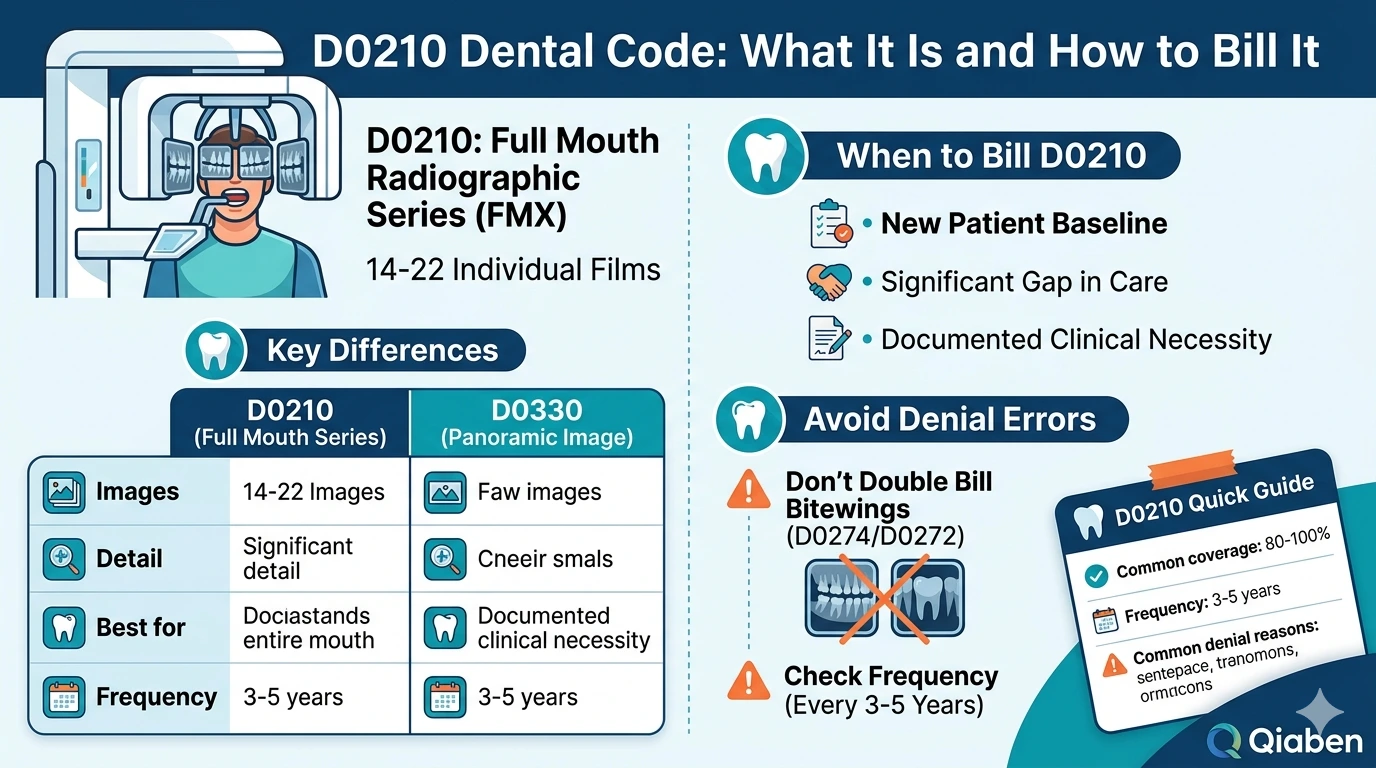
- Train clinical staff in documentation of high-dollar codes (e.g., D4341, D2750).
- Utilize cheat sheets or code libraries through the PMS
Tip: Use a billing service that does a monthly analysis of your coding and actively trains your staff on future changes.
4. Standardize and Reinforce Documentation
Insurance companies are now requiring more detailed documentation than ever before. Claims frequently require:
- Accurate SOAP or DAP notes.
- Radiographs and intraoral photos.
- Periodontal charting on SRP claims.
- Stories that bear relevance to the clinical scenario
Why it matters: A single missing piece can cause a delay—or even a denial. Your
billers must collaborate with clinicians to establish templates that yield complete, accurate, and defensible documentation each and every time.
5. Deny Fever by Leveraging Data
Denials are frustrating—also costly. An efficient billing system traces each denial, examines the reason, and streamlines workflows accordingly.
Key KPIs to monitor:
- Denial rate by procedure and provider.
- First-pass resolution rate.
- Average days in AR by insurance company
Monitoring these metrics on a regular basis allows you to resolve systemic problems (like improper codes or lack of documentation) and optimize your first-pass claim acceptance.
6. Be HIPAA and Cybersecurity compliant
Cyber attacks are more common than ever. Non-compliant practices risk data breaches, fines, and loss of patient trust.
Security measures to adopt:
- Encrypted cloud-based billing systems.
- Multi-factor authentication (2FA).
- User access logs and audit trails.
- Staff training on PHI protection and phishing threats
Billing teams need to be both revenue defenders and data guardians. Select vendors who value compliance at every step.
7. Consider In-House vs. Outsourced Billing
In 2025, most practices are making the transition to outsourced billing partners—or adopting a hybrid model. Here’s what to think about:
In-House Billing Pros:
- Close working with the clinical team.
- Direct control over workflows
In-House Cons
- High staff turnover.
- Shortened training time or coding revisions.
- Risk of delay due to vacation or burnout
Benefits of Outsourced Billing
- Access to specialists who remain current on CDT codes, insurance regulations, and denial trends.
- 24–48 hour turn-around on filing claims.
- Potential to expand without the need to add headcount
Disadvantages of Outsourcing
Decreased visibility by the day (unless employing an open vendor)
Solution: Most effective practices today employ a hybrid approach—doing insurance verification and patient billing question processing in-house, but outsourcing claim submission, coding, and AR follow-up to a firm like Qiaben Health.
8. Automate AR Follow-Up and Collections
Delinquent balances can destroy a dental practice. To maximize AR:
- Implement automated reminders for delinquents.
- Apply text/email tools for collections from patients.
- Outsource AR recovery for accounts >60 days delinquent
Sophisticated billing systems also take advantage of analytics to prioritize follow-ups based on claim value or payer trends, cutting time and maximizing ROI.
9. Optimize Billing Efficiency Using Metrics
Don’t guess—measure. The top performers of 2025 use data to monitor billing
performance in the most critical areas.
Track these core KPIs:
- Claim submission lag (goal: <48 hours).
- Net collection rate (goal: 98%+).
- Insurance AR>90 days (goal: <10%).
- Denial reversal rate
By monitoring and refining these figures monthly, you have your billing engine getting better month by month.
10. Train Your Staff on New Tools and Trends
- New CDT updates.
- HIPAA and cyber attacks.
- Utilizing AI-powered tools.
- Understanding EOBs and denials management
Tip: Qiaben Health provides on-demand staff training and monthly update briefings to all clients.

Case Study: How Practice Collected $180K More in 6 Months
Dr. Lisa Chang, a Chicago dentist, was losing $30K+ per month because of outdated systems, high turnover, and unresolved denials. Since switching to Qiaben Health:
- Claim submission time reduced from 6 days to under 48 hours.
- Denial rate reduced from 19% to 6%.
- Collections increased from $110K to $180K/month.
“Qiaben provided us with systems, strategy, and peace of mind,” says Dr. Chang. “I’ve never felt more confident about our billing.”
Final Thoughts: Tum Billing into a Growth Engine, Not a Bottleneck
Billed does not have to be a time-consuming, agonizing process. In fact, when done correctly, billing is a growth engine that drives your practice forward.
By leveraging automation, enhancing compliance, monitoring metrics, and working with experts such as Qiaben Health, you can:
- Boost collections.
- Decrease staff burnout.
- Enhance patient satisfaction.
- Drive sustainable growth.