The D0210 dental code is one of the most commonly billed diagnostic codes in dentistry — and also one of the most commonly denied. If you’re a dental biller or front office coordinator handling claims, understanding exactly how this code works will save you a lot of time on follow-up and appeals.
What Is the D0210 Dental Code?
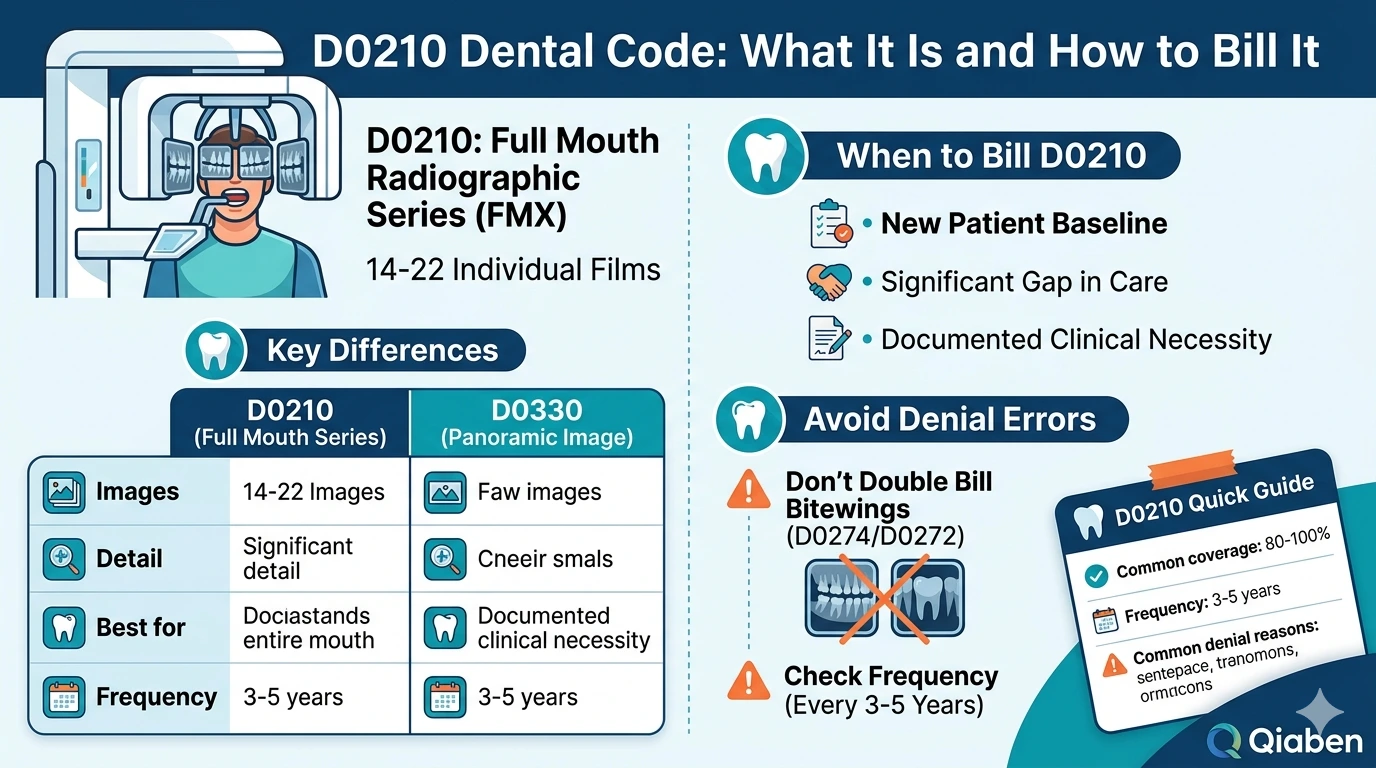
The D0210 dental code is the CDT procedure code for a full mouth series of radiographic images — also called an FMX (Full Mouth X-ray). It’s the complete set of x-rays a dentist takes to get a detailed picture of every tooth, root, and surrounding bone throughout the entire mouth. This is the gold standard for a comprehensive radiographic examination, typically done at a patient’s first visit or after a significant gap in care.
D0210 vs. D0330: What’s the Difference?
Feature | D0210 (Full Mouth Series) | D0330 (Panoramic Image) |
Images | 14–22 individual films | One large image |
Detail | High — tooth-by-tooth | Broad overview |
Best for | Caries, bone loss, periapical pathology | Jaw overview, impaction, growth |
Frequency | Every 3–5 years | Every 3–5 years (plan-specific) |
When Should You Bill D0210?
New patient comprehensive exam.
A patient is new to the practice, no prior radiographic records are available for transfer, and a full series is needed to establish a baseline.
Returning patient after a significant gap in care.
If a patient hasn’t been seen in several years and their benefit period allows for a new series.
Clinical necessity before the frequency period.
If there’s documented active disease — significant bone loss, active caries, post-trauma evaluation — some insurers will cover D0210 before the standard frequency window.
Frequency Limitations
- Adults: once every 3–5 years
- Children/adolescents: every 3 years in most plans
- Some plans reset the clock from the date x-rays were last taken
Always verify the patient’s radiograph history as part of insurance verification. Call the insurer directly before the appointment — not after a denial.
Common Denials for the D0210 Dental Code
Frequency limitation exceeded.
The patient had an FMX taken within the frequency window at a previous practice, and that history followed them through insurance records.
Bundling with bitewing codes.
The D0210 dental code includes bitewing images. If your office also billed D0272 or D0274 on the same date, the insurer will deny the bitewing codes.
Missing attachment.
Some plans require a tooth chart, periodontal chart, or clinical notes when submitting D0210.
Wrong date of service.
Bill the date the x-rays were actually taken, not the exam date.
Tips for Clean D0210 Claims
- Verify radiograph history at every new patient appointment
- Don’t bundle bitewing codes — they’re included in D0210
- Document in the chart before submitting
- Know which plans require attachments
- Track your FMX denial rate — above 10–15% means something in the workflow needs to change
D0210 Quick Reference
Field | Detail |
CDT Code | D0210 |
Category | Diagnostic — Radiographs |
Typical Image Count | 14–22 films |
Frequency (Adult) | Every 3–5 years |
Includes Bitewings? | Yes — don’t bill D0272/D0274 separately |
Common Denial Reasons | Frequency, bundling, missing attachment |
Typical Coverage | 80–100% under diagnostic |
Final Thoughts
The D0210 dental code is straightforward when the workflow around it is solid. Verify frequency before the appointment, document the clinical reason clearly, and don’t double-bill bitewings. Most D0210 denials are preventable.
If you’re seeing consistent denials on the D0210 dental code, Qiaben’s billing team can help audit your claims and identify the pattern. Reach out here.