INTRODUCTION
Mental health professionals increasingly rely on electronic health records software to streamline patient care, improve documentation accuracy, and ensure compliance. While many premium EHR platforms dominate the market, free and open-source solutions are steadily gaining popularity among small practices and solo providers. These systems often deliver impressive functionality without the heavy price tag, making them especially appealing to behavioral and mental health specialists operating on tight budgets.
Why Mental Health Providers Will Need Specific EHR Software There is a general software misuse amongst professionals which is an EHR system. Systems are very different however people providing service in the field of mental health often lose patients because they’re not familiar how to deliver services like through Telehealth EHR system that opt for different mechanisms to reach their customers.
There are:

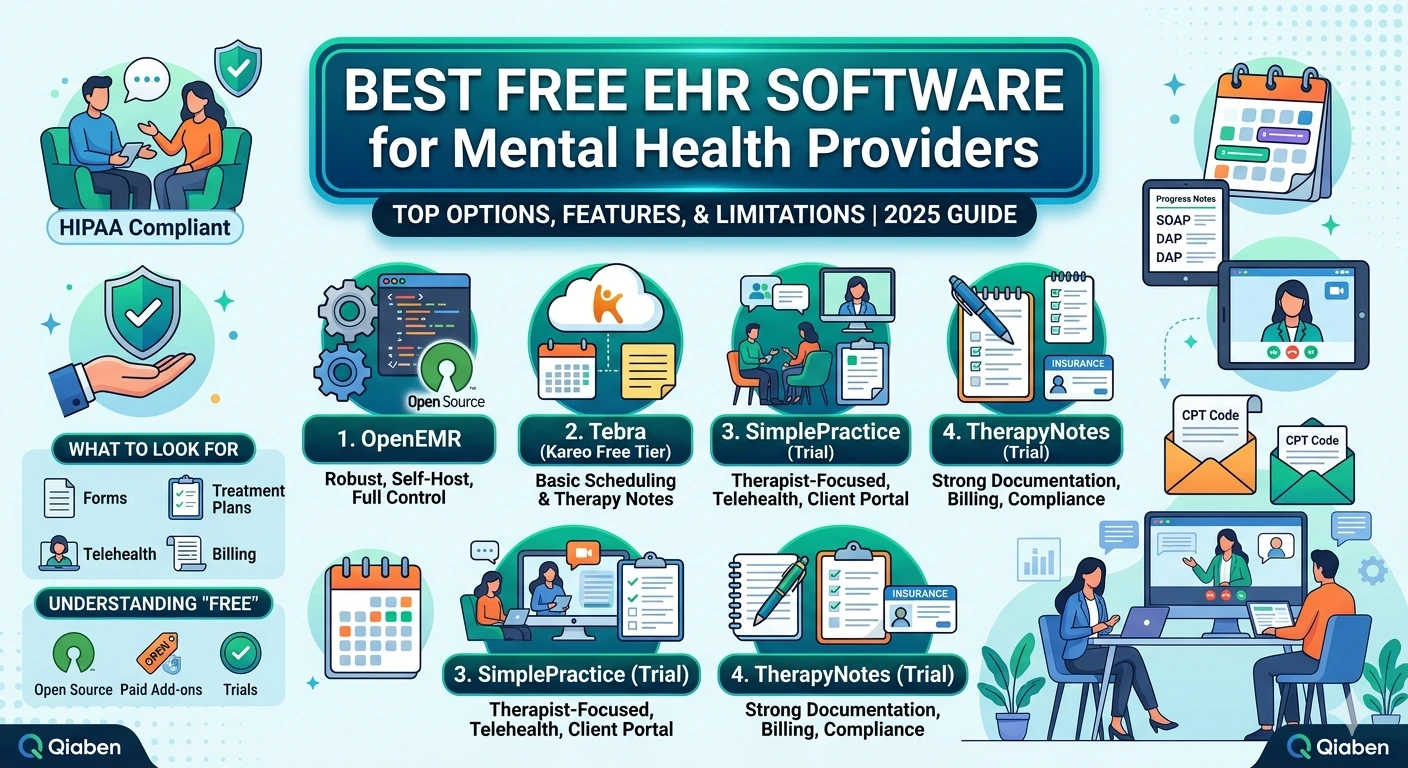
Best Free EHR Software for Mental Health Providers
Many EHR software is available free of cost, and developed keeping in view the certain needs of the mental health practitioners. A few of the best providers with critical capabilities that have earned them respect in the industry are listed below.
1. Qiaben EHR
Overview:
Qiaben EHR is a responsive cloud EHR system for any healthcare provider, and whether that is a mental health provider or simply any healthcare provider, it can work.
Most EHR systems are compatible with the majority of general healthcare practices. Nevertheless, some of the unique features of Qiaben EHR can only be availed by a mental health provider such as customized therapy note templates integration for telehealth, and even tracking minute details of progress.
Key Features:
This system enables the mental health providers to make customize templates for therapy notes, patient assessments, and treatment plans. This tool has patient progress monitoring; this is a feature through which providers can track the success of treatment. Other mainstream features that Qiaben avails include secure telehealth functionality, which enables easier remote therapy sessions for providers. The service also offers encrypted and HIPAA compliant data storage which ensures best practices are followed when handling sensitive patient information by the providers.
Benefits:
- Login for mental health
- Advanced security telehealth integration
- HIPAA compliant security
- Custom templates with progress tracking
Drawbacks:
Qiaben EHR comes with a free account; however, the AI-driven analytics along with enhanced reporting features will only be available with paid account
VistA: A Veteran-Proven System
The Veteran Administration’s Computerized Patient Record System (VA CPRS), better known as VistA, is one of the most respected open-source electronic health records software platforms. Widely used across the VA healthcare system, VistA has built a reputation for stability and adaptability.
Its success demonstrates that open-source EHRs can operate at scale and meet high satisfaction standards. While VistA may be more complex to implement in small private practices, it’s proof that free solutions can deliver enterprise-level reliability.
Practice Fusion: Market Share in Small Practices
Practice Fusion is another strong example of how free EHRs have carved out market space. According to surveys, it holds 15% of the solo ambulatory market and 12% of small practices with one to three clinicians.
Designed with smaller healthcare teams in mind, Practice Fusion has become a popular choice for providers seeking cost-effective EHR solutions. However, it operates under a freemium model, meaning some advanced features and support come with additional costs.
OpenEMR: A Global Leader in Open Source
OpenEMR is one of the most widely adopted free electronic health records software platforms. Certified by the ONC, it offers:
Complete EHR functionality
Scheduling and practice management
Electronic billing integration
Cloud or on-premises deployment
OpenEMR is flexible enough to run on Windows, Linux, or Mac OS X, and providers can choose between hosting it on their own servers or using a cloud-based setup. With over 15,000 global installations and 3,000 monthly downloads, OpenEMR continues to be one of the most trusted open-source EHR options available today.
OpenMRS: Customizable and Community-Driven
OpenMRS is another open-source platform designed to allow healthcare professionals to build a customized medical records system. Its modular, concept-dictionary structure makes it highly adaptable and capable of supporting diverse clinical workflows.
Key strengths of OpenMRS include:
Open-source code under the Mozilla Public License
Strong interoperability and scalability
Deployment on laptops, local servers, or cloud environments
With support from a community spanning 80+ countries and 8,000+ sites, OpenMRS stands out as a collaborative solution backed by global expertise. For mental health providers looking for customization and international community support, it’s a powerful contender.
Hippocrate: Free EHR with Big Data Features
Hippocrate, developed by a nonprofit organization, aims to democratize healthcare technology. This free cloud-based EHR is particularly attractive for solo providers, with a paid option available for larger practices.
Its features go beyond basic records management, offering:
Telemedicine capabilities
Patient engagement tools
Productivity and revenue analytics
A secure, encrypted Medical Social Network for referrals and collaboration
Hippocrate is compliant with ICD-10 and SNOMED standards, making it suitable for practices focused on secure data handling and analytics. For mental health professionals, its emphasis on collaboration and patient communication tools may be especially valuable.
Benefits of Free EHR Software for Mental Health Providers
Mental health practitioners who are operating in small offices or doing private practice enjoy interesting features that are packed in the free EHR application:
Reduced Overhead Cost: Free EHR reduces overheads in a way that more money is saved for provision of services. For example, Qiaben EHR offer features that will otherwise be availed by expensive software that make an EHR system.
Efficiency: Administrative tasks are integrated within the EHR systems and therefore avoid wastage of time and resources when documenting, scheduling, and billing. This will open up many opportunities for mental health providers to engage in providing quality care to patients.
Telehealth Functions: As many patient’s clients are getting teletherapy or using it, it is essential that the tele health capability be included. The EHR offered by Qiaben EHR in so far as patients is concerned has some secure tools for telehealth connection that is free.
Security: Let us then therefore say that in mental health care delivery, patient records or documents remain practical and vital elements and hence such have to be protected. The other aspect in relation to Zeros EHR services is that of e-Record services such as those by Qiaben EHR and other services claim to be HIPAA compliant and thus have the necessary encryption and data storage access restrictions.
Conclusion:
Mental health practitioners have a few unique characteristics in that managing patient information and clinical workflows come with a few specific demands. There are free EHR solutions such as Qiaben EHR, TheraNest and SimplePractice that provide practitioners with minimum tools that assist in documentation, compliance, and facilitating safe telehealth practices. Of such options, the most impressive would be Qiaben EHR and therefore this makes it the best alternative in ensuring that mental health practitioners can practice in a cost effective manner.
The main point that stands out in this case is that the use of free EHR not only helps in addressing the administrative side of the practice but also enhances the quality of care that is delivered.