Running a mental health practice already comes with enough overhead. The idea of paying hundreds of dollars a month for EHR software on top of everything else — especially if you’re a solo therapist, a small group practice, or a community clinic working within tight margins — is genuinely difficult.
The good news is that free EHR software for mental health does exist, and some of it is actually good. The less encouraging news is that “free” almost always comes with trade-offs, and understanding what those are before you commit is important.
What to Look For in Free EHR Software for Mental Health
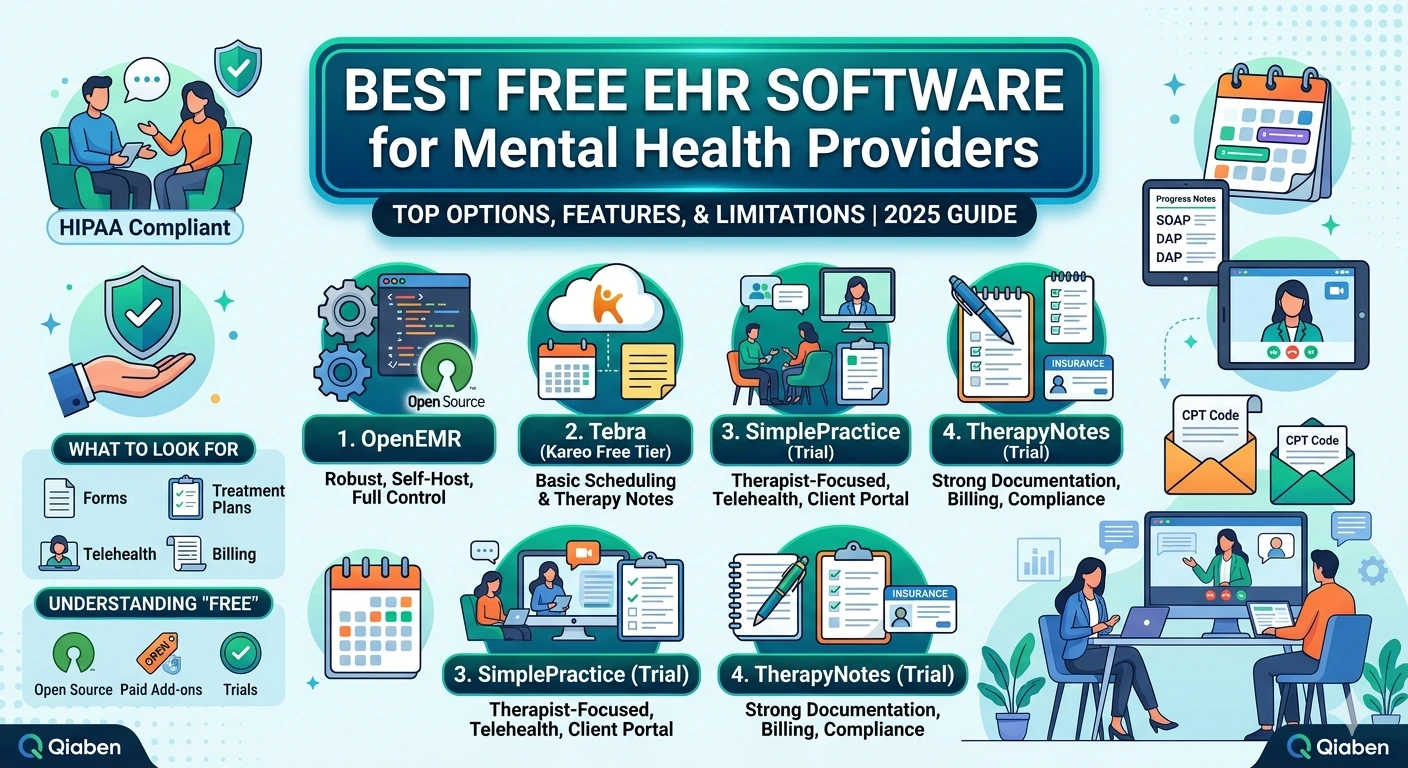
Mental health practices have specific needs that differ from primary care or dental. The EHR has to handle:
- Progress notes in therapy-appropriate formats (SOAP, DAP, BIRP)
- Treatment plans with goals, objectives, and review timelines
- Consent forms and intake documents that are signable within the platform
- Scheduling with appointment reminders
- HIPAA compliance — non-negotiable, regardless of cost
- Billing support — CPT codes for mental health, insurance claim submission, or superbills
- Telehealth — increasingly a standard requirement
1. OpenEMR
OpenEMR is the most well-known free EHR software for mental health and general practice alike. It’s fully open-source, which means there’s no licensing fee ever — and you can customize it extensively if you have technical resources.
OpenEMR handles clinical documentation, scheduling, billing (including claim submission), patient portal, e-prescribing, and reporting. For mental health, you can configure note templates for therapy-specific formats and build treatment plan workflows.
HIPAA compliance: OpenEMR is HIPAA-capable, but compliance depends on how it’s implemented. If you’re self-hosting, your hosting environment, access controls, and backup procedures are your responsibility.
Best for: Practices with technical capacity, community health centers, and organizations that want full control over their data without ongoing licensing costs.
2. Kareo (Now Tebra) — Free Starter Tier
Tebra has historically offered a free tier for small practices, including basic scheduling, clinical notes, and patient communication features. The platform is designed with mental health workflows in mind and includes note templates for behavioral health.
Limitations: The free tier is limited in scope. Billing, advanced reporting, and telehealth typically require a paid subscription.
Best for: Solo therapists who need basic scheduling and notes and handle billing separately.
3. SimplePractice — Free Trial
SimplePractice is one of the most popular EHR platforms specifically built for mental health providers. It’s not permanently free, but its generous trial period makes it one of the top options discussed as free EHR software for mental health.
It includes scheduling, telehealth, progress notes, treatment plans, billing, insurance claim submission, client portal, and intake forms. It’s purpose-built for therapists, counselors, and behavioral health providers.
Best for: Mental health providers who want the best purpose-built platform and can budget for a monthly fee after evaluating it.
4. TherapyNotes — Free Trial Model
TherapyNotes is widely used and well-regarded in the therapy community. The note-writing experience is particularly strong — the platform guides you through documentation in a way that helps meet payer and licensing board requirements. Like SimplePractice, it converts to paid after the trial.
Best for: Practices where documentation quality and compliance are the top priority.
What “Free” Usually Means in EHR Software
Most free EHR software for mental health is free in one of these ways:
Open source with hosting costs.
The software itself is free (OpenEMR), but you’ll pay for hosting, setup, and maintenance. Total cost varies from $20/month (basic managed hosting) to several hundred depending on configuration.
Free tier with paid features.
The core is free, but billing, telehealth, or advanced features cost extra.
Free trial that converts to paid.
Technically costs money after a defined period.
There is no completely free, fully featured, zero-compromise EHR for mental health. Understanding which trade-offs you’re willing to make is the real question.
Questions to Ask Before Choosing
- Do you take insurance? If yes, you need billing and claim submission built in or integrated.
- Do you do telehealth? Make sure the platform includes a HIPAA-compliant video option.
- How many clients do you see? Some free tiers cap the number of active client records.
- Who manages the tech? Open source platforms are free but require someone to maintain them.
- What’s your note format? Make sure the EHR supports the structure your licensing board expects.
Final Thoughts
Finding the right free EHR software for mental health comes down to being honest about what your practice actually needs versus what it can manage. For practices with technical capacity and no budget for licensing fees, OpenEMR is the most robust free option available.
Qiaben works with mental health practices on EHR setup, billing integration, and claims support. If you’re evaluating systems or need help configuring OpenEMR for a behavioral health workflow, our team is here to help.