If you take a glance at a dental billing, it might as well be a foreign language. Unfamiliar letters and numbers mixed—in the form of D0210, D0330, or D0230—don’t mean much to the typical patient. However, to dentists, insurance providers, and billing staff, these codes are paramount.
One of the most frequently asked questions is about the FMX dental code, also known as the full mouth x-ray series. In this guide, we’ll break down what FMX means, how it’s different from a panoramic x-ray, and what the most common CDT radiograph codes stand for.
What Is an FMX Dental Code?
An FMX (short for Full Mouth X-rays) is a series of complete pictures inside your mouth. They are all the teeth, the roots, and the surrounding bone structure.
- CDT Code D0210 is the standardized code for an FMX.
- An FMX typically consists of 14 to 22 small x-rays (a combination of periapical and bitewing radiographs).
- These pictures are what dentists use to search for cavities, bone loss, infection, and other oral complications.
In plain terms, FMX is like giving your dentist a full “blueprint” of your mouth.
What Does FMX Stand for in Dentistry?
FMX stands for Full Mouth X-rays.
Your dentist might recommend an FMX if:
- You’re a new patient and haven’t had one in a while.
- You have gum disease or bone loss.
- You’re undergoing major treatment (implants, braces, or oral surgery).
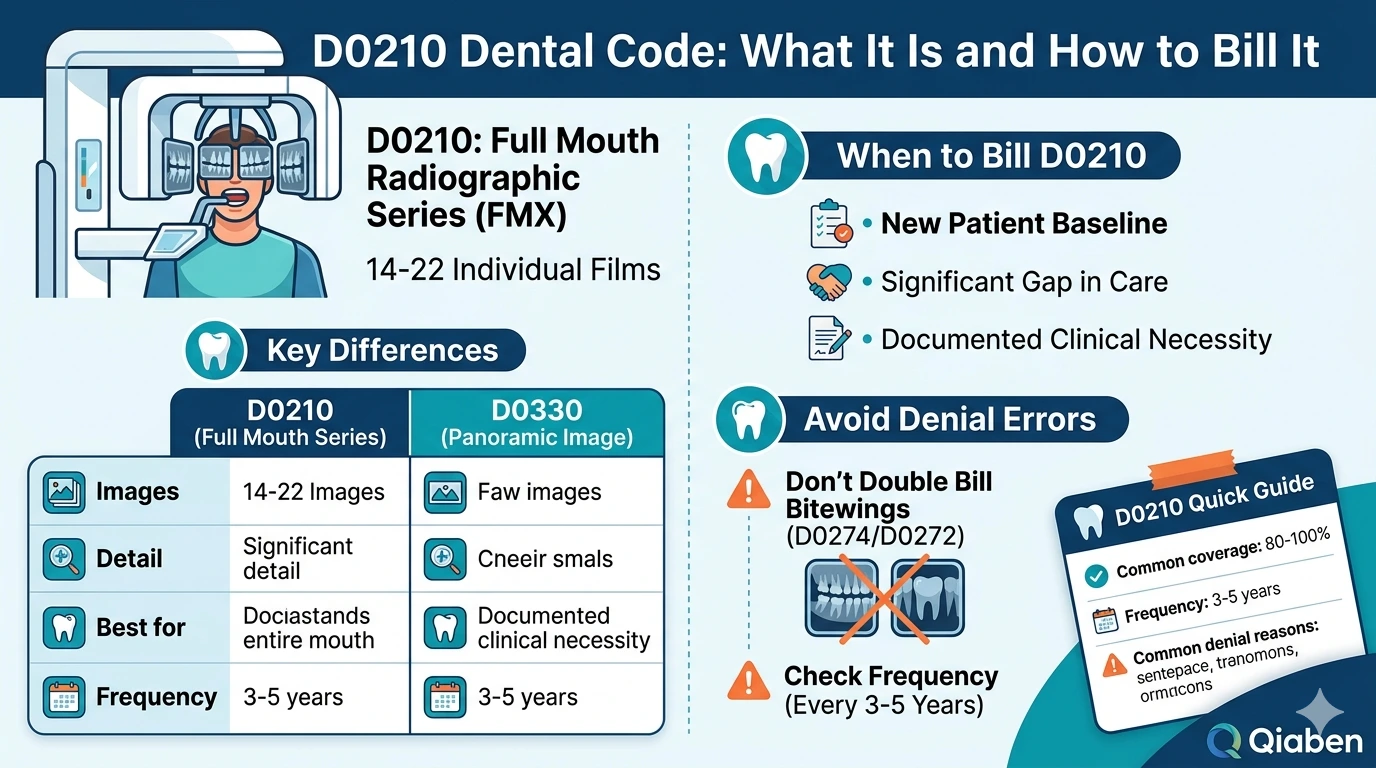
Most individuals don’t require a full mouth series annually. Their insurance will usually pay for it every 3–5 years, unless a medical necessity dictates taking one earlier.
FMX vs. Panoramic: D0210 and D0330 Clarified
There are two codes that become jumbled: D0210 (FMX) and D0330 (panoramic x-ray). Let’s set that straight.
D0210 – FMX (Full Mouth Series of Intraoral X-rays)
- Taken within your mouth with little sensors or film.
- Several images pieced together.
- Extremely detailed view of teeth, roots, and bone.
- Insurance covers this every 3–5 years.
D0330 – Panoramic X-ray (Panorex)
- Done outside your mouth all at once.
- Makes one 2D picture of your whole jaw.
- Useful to view wisdom teeth, jaw issues, or orthodontic treatment.
- Coverage policies might vary from FMX.
Fast fact:
- D0210 = FMX = many detailed intraoral images.
- D0330 = Panoramic = one big external image.
Common Dental X-ray Codes You Should Know
Here is a list of the most common CDT x-ray codes used:
D0210 – Intraoral Complete Series (FMX)
- The complete full mouth x-ray series (14–22 images).
- New patient or continuing care patient baseline record.
D0220 – Periapical, First Image
- Your dentist uses this when they take one periapical x-ray.
- Typically for a problem tooth or infection examination.
D0230 – Periapical, Each Additional Image
- Charged for additional periapical films above the initial.
- Always associated with D0220.
D0274 – Four Bitewing Images
- Four routine bitewing x-rays (two on each side).
- Taken to identify cavities between teeth and measure bone levels.
D0330 – Panoramic Image
- One big “big picture” x-ray of your whole mouth and jaws.
- Often used for wisdom teeth, orthodontics, and oral surgery.
D4341 – Scaling and Root Planning (SRP)
- Not an x-ray code but usually associated with diagnostic imaging.
- Refers to a deep cleaning process for gum disease.
Related: Understand periodontic CDT codes (D4000–D4999) for scaling, root planing, and periodontal care.”
Dental Code for Panoramic X-ray
The CDT code for panoramic x-ray is D0330.
This code is used when the dentist must visualize:
- All supporting bone and teeth in a single image.
- Wisdom tooth alignment.
- Jaw joints (TMJ) or structural concerns.
- Cysts, tumours, or growths.
Panoramic x-rays are simple, painless, and quick.
Why Do These Codes Matter?
Dental codes aren’t only for insurance companies—they’re important to you, as well.
- For providers: Accurate coding averts claim denials and accelerates reimbursement.
- For patients: You can better understand your bill and what your insurance really covers when you know what codes represent.
Each year, the American Dental Association (ADA) revises CDT codes. That means dentists and billing staff must remain up to speed on revisions to prevent mistakes.
FAQs About FMX and Dental X-ray Codes
What is the FMX dental code?
The code for FMX is D0210, which provides a full mouth series of intraoral x-rays.
What is FMX?
FMX = Full Mouth X-rays, typically 14–22 tiny pictures.
What is the difference between D0210 and D0330?
- kevinwestephens.com
- D0210 = series of intraoral full mouth images (several images).
- D0330 = panoramic picture (one broad photo).
What is the dental code for a panoramic x-ray?
That would be D0330.
What is the code for four bitewing x-rays?
The CDT code for this is D0274.
What does D0230 represent?
D0230 includes each subsequent periapical film taken subsequent to the initial one (D0220).
Best Practices for Dental Billing and Coding
- Stay current: CDT codes are updated annually by the ADA.
- Document thoroughly: Always record why x-rays were being taken.
- Include narratives when necessary: Particularly when medical necessity could be questioned.
- Educate patients: Explanation prevents billing surprises.
- Consider outsourcing billing: Most practices utilize third-party billing companies to conserve time and prevent expensive errors.
Final Thoughts
Knowledge of FMX dental code (D0210) and companion x-ray codes is beneficial for patients and dental practitioners alike.
- FMX (D0210) is the standard code for a full mouth intraoral series.
- Panoramic (D0330) offers a wider single-image overview.
- Codes such as D0220, D0230, and D0274 address specific bitewing and periapical requirements.
For patients, understanding these codes translates to fewer surprises on your bill. For dentists, accurate coding translates to smoother approvals of claims and improved cash flow.
Pro Tip: If your dental practice experiences denied claims or delayed billing, outsourcing your billing to experts can make a significant impact.