
Where Does Your Practice Lose Revenue? 9 Medical Coding Gaps to Check
09/09/2026 7 min read
Revenue loss does not always come from low patient volume or unpaid bills. Sometimes, the problem starts much earlier, with medical coding gaps. A missed code, incorrect diagnosis code, incomplete documentation, or outdated coding rule can affect how a claim is processed. Even small coding mistakes can lead to claim denials, delayed payments, underpayments, or lost revenue.
Here are 9 medical coding gaps your practice should check.
1. Missing Procedure Codes
One of the simplest ways a practice can lose revenue is by failing to capture a service that was actually provided.
For example, a provider may perform multiple services during one patient visit, but only some of them make it into the billing system. When a service is missing from the claim, the practice may never receive payment for it.
What to check:
- Are all services documented?
- Do the charges match the provider's notes?
- Are completed procedures being captured?
- Are there differences between clinical documentation and submitted claims?
Regular charge and coding reviews can help identify missed services before they become lost revenue.
2. Incorrect ICD-10 Codes
ICD-10 codes communicate the patient's diagnosis or condition. Choosing the wrong code can create problems with claim processing and reimbursement. A code may be too general, incorrect for the patient's condition, or not supported by the documentation.
What to check:
- Is the diagnosis supported by documentation?
- Is the code specific enough?
- Is the correct diagnosis code being used?
- Are coders following current ICD-10 guidelines?
Accurate diagnosis coding helps create cleaner and more complete claims.
3. Incorrect CPT or HCPCS Coding
CPT and HCPCS codes are used to report many of the services, procedures, and supplies provided to patients. Using an incorrect procedure code can result in claim rejection, incorrect reimbursement, or additional work for the billing team.
The problem may happen because a coder selects a similar-looking code without carefully reviewing the documentation. For a deeper understanding of CPT coding, guidelines, modifiers, and their role in accurate reimbursement, read Qiaben's guide to CPT codes in medical billing.
4. Missing or Incorrect Modifiers
Modifiers provide additional information about a service. They can explain circumstances surrounding a procedure and help payers understand why a particular service was billed. When a required modifier is missing or used incorrectly, a claim may be denied or processed incorrectly.
However, modifiers should not be added simply to increase reimbursement. They must be supported by the documentation and applicable coding rules.
What to check:
- Are required modifiers included?
- Are modifiers supported by the medical record?
- Are staff using modifiers correctly?
- Are frequently denied claims showing the same modifier problem?
A regular review can help identify patterns before they become repeated revenue leaks.
5. Upcoding or Downcoding
Coding should accurately represent the services provided. Choosing a higher-level code than the documentation supports is known as upcoding, while choosing a lower-level code can result in lost revenue. Upcoding can create serious compliance concerns, while downcoding may cause the practice to receive less reimbursement than it should.
The goal is to choose the correct code supported by the documentation.
What to check:
- Do the codes match the actual services?
- Does documentation support the selected level?
- Are providers and coders following coding guidelines?
- Are certain codes being used unusually often?
Regular audits can help identify both compliance risks and missed revenue.
6. Documentation Does Not Support the Code
Coding accuracy starts with good documentation. If a provider's documentation does not clearly support the diagnosis or service reported on a claim, the coder may have difficulty selecting the correct code.
This can lead to queries, claim delays, denials, or incorrect reimbursement.
What to check:
- Is the provider's documentation complete?
- Does the documentation support the diagnosis?
- Does it support the procedure performed?
- Are important details missing?
Better communication between providers and coding teams can help close these gaps.
7. Using Outdated Codes or Guidelines
Medical coding changes regularly. New codes are introduced, existing codes may be revised, and coding guidelines can change. If a practice continues using outdated information, claims may be rejected or coded incorrectly.
This is especially important when coding teams handle a large number of claims across different specialties.
What to check:
- Are coding resources updated?
- Are coders trained on annual changes?
- Is outdated software or reference material still being used?
- Are internal coding guidelines reviewed regularly?
Keeping coding knowledge current can prevent avoidable errors.
8. Payer-Specific Coding Rules Are Being Missed
Not every payer processes claims in exactly the same way. Insurance companies may have specific requirements for certain procedures, diagnoses, modifiers, documentation, or claim submissions.
A code that works correctly for one payer may still require additional information for another.
What to check:
- Are payer-specific requirements being reviewed?
- Are common payer denials tracked?
- Are authorization requirements connected to coding workflows?
- Does the billing team review payer policies regularly?
Tracking payer patterns can help your practice identify recurring coding problems.
9. No Regular Coding Audit
One of the biggest gaps is not checking for coding gaps at all. If your practice only looks at coding after a claim is denied, you are already reacting to the problem.
Regular coding audits can help identify mistakes before they affect a large number of claims.
A simple audit can review:
- Diagnosis codes
- Procedure codes
- Modifiers
- Documentation
- Missed charges
- Code updates
- Payer requirements
- Denial patterns
The goal is not to find fault with individual employees. It is to identify process problems and improve accuracy.
How Medical Coding Gaps Turn Into Revenue Loss
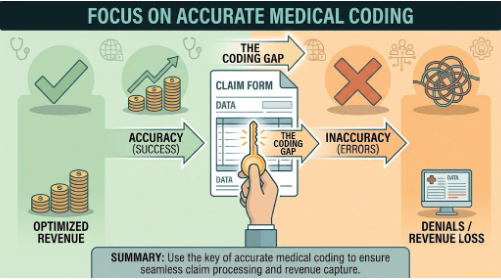
A coding mistake may look small when viewed on a single claim. But imagine the same mistake happens across dozens or hundreds of claims. A missing procedure code can mean missed revenue. An incorrect diagnosis can result in a denial. A missing modifier can delay payment. Incomplete documentation can create additional work for providers and coders.
Over time, these small problems can become a significant revenue leak. That is why practices should look at coding as more than a back-office task. Accurate coding is an important part of the revenue cycle.
How Professional Coding Support Can Help
For practices dealing with high claim volumes, keeping coding accurate can become difficult. Internal teams may be managing documentation, coding updates, claim deadlines, payer rules, and other administrative tasks at the same time.
Professional medical coding services can provide additional support by reviewing documentation, assigning appropriate codes, identifying potential errors, and helping practices maintain consistent coding processes.
Final Thoughts
Revenue loss can hide inside everyday coding processes. A missing procedure, incorrect diagnosis code, outdated code, unsupported modifier, or documentation gap may seem like a small issue. But when the same mistake happens repeatedly, the financial impact can become much larger.
That is why practices should regularly review their coding workflows, monitor denial patterns, update their coding knowledge, and check whether documentation supports the codes being submitted.
At Qiaben, we're committed to helping healthcare providers simplify medical billing and revenue cycle management. Explore more expert insights on our blog, and if you have questions or need support with your billing processes, get in touch with our team.