
What Makes a Patient Assessment Insurance-Billable?
09/11/2026 5 min read
A patient assessment may provide valuable clinical information, but that does not automatically mean it can be billed to insurance. For an assessment to be insurance-billable, the service generally needs to meet the applicable payer's requirements for medical necessity, documentation, coding, and coverage.
For practices providing assessment-based care, understanding these requirements can help reduce billing problems and improve the accuracy of claims.
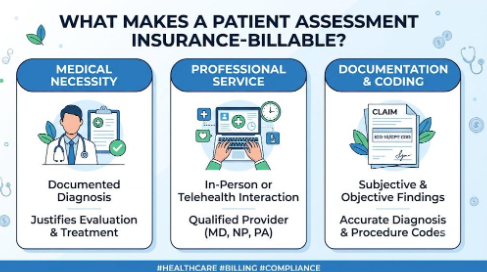
1. The Assessment Must Be Medically Necessary
Medical necessity is one of the most important factors in determining whether a service is payable. The assessment should have a clear clinical purpose and be appropriate for the patient's condition.
The documentation should explain why the assessment was needed and how it relates to the patient's symptoms, condition, or treatment needs. CMS states that medical necessity is a key criterion for payment for evaluation and management services.
An assessment should therefore not be performed or billed simply because a particular code is available. The clinical reason for the service should be clear.
2. Documentation Must Support the Assessment
Good documentation provides the foundation for a billable assessment.
The patient's record should clearly describe the reason for the assessment, relevant findings, clinical observations, and the provider's assessment or conclusions. The documentation should support the service and level being reported on the claim.
CMS guidance emphasizes that medical records should support the CPT, HCPCS, and ICD-10-CM codes reported on a claim.
3. The Correct Code Must Be Selected
Once the assessment is documented, the appropriate billing code must be selected based on the service actually provided.
The code should match the nature and complexity of the assessment rather than being selected simply because it produces a higher reimbursement amount. Using an incorrect or unsupported code can result in a claim rejection, denial, or additional review.
4. The Provider Must Meet Payer Requirements
Insurance companies may have specific rules regarding who can perform or bill for an assessment, what documentation is required, and whether authorization is necessary.
Before billing, practices should confirm the applicable payer requirements. A service may be clinically appropriate but still face payment problems if a required authorization, provider qualification, or coverage condition has not been met.
5. The Assessment Should Be Clearly Connected to the Patient's Condition
A strong assessment record should make the connection between the patient's condition and the service easy to understand.
For example, documentation should explain relevant symptoms, concerns, clinical findings, or functional limitations that support why the assessment was performed.
This makes it easier for a payer or reviewer to understand the purpose of the service without having to guess from incomplete information.
6. Coding and Documentation Should Match
One of the most important checks before submitting a claim is comparing the assessment documentation with the code being billed.
If the record describes a limited assessment but the claim reports a more extensive service, the mismatch can create a billing problem. The same applies when documentation is missing information required to support the selected code.
A simple pre-submission review can help identify these inconsistencies.
7. Insurance Coverage Should Be Verified
Even when an assessment is medically necessary and properly documented, coverage can vary by insurance plan.
Before providing the service when practical, staff should verify the patient's eligibility and determine whether the assessment is covered. They should also check applicable deductibles, copayments, authorization requirements, and limitations.
Clear communication about expected costs can also help prevent confusion later. Qiaben's article Patient Payment Psychology: Why Dental Bills Feel Scarier Than Dental Pain and How Qiaben Changes That discusses how explaining insurance coverage, charges, and payment expectations can reduce patient confusion.
8. Keep the Assessment Record Complete
A complete record should provide enough information to show what was assessed, why it was assessed, what was found, and how the findings relate to the patient's care.
Practices should avoid relying on generic notes that do not adequately describe the individual patient's situation. Documentation should reflect the actual service provided.
How Clinical Assessments Services Can Support Billing
For practices that perform a large number of assessments, maintaining consistent documentation and billing workflows can become difficult.
Clinical assessments services can help practices organize assessment workflows, support proper documentation, and make it easier to align clinical information with applicable billing requirements. The goal is not simply to make an assessment billable, but to ensure that the assessment is clinically appropriate, properly documented, and accurately represented on the claim.
Common Reasons an Assessment May Have Billing Problems
Some common issues include incomplete documentation, lack of medical necessity, incorrect coding, missing authorization, inactive insurance coverage, and failure to meet payer-specific requirements.
These problems can often be identified before claim submission through a simple review process.
Final Thoughts
An insurance-billable patient assessment requires more than completing an evaluation. The service should have a clear clinical purpose, meet applicable medical-necessity requirements, be properly documented, correctly coded, and satisfy the patient's insurance and payer requirements.
When clinical documentation, coding, insurance verification, and billing work together, practices can create a more reliable assessment workflow and reduce avoidable claim problems.
At Qiaben, we're committed to helping healthcare providers simplify medical billing and revenue cycle management. Explore more expert insights on our blog, and if you have questions or need support with your billing processes, get in touch with our team.