
What Is CAQH and Why Do Physicians Need It? A Simple Guide
09/07/2026 6 min read
If you are a physician joining a medical practice, starting a new practice, or trying to participate in insurance networks, you may come across the term CAQH. For many physicians, CAQH can seem like another administrative requirement filled with forms, documents, and updates. But understanding what CAQH is and how it fits into the credentialing process can make the process much easier.
So, what exactly is CAQH, and why do physicians need it?
What Is CAQH?
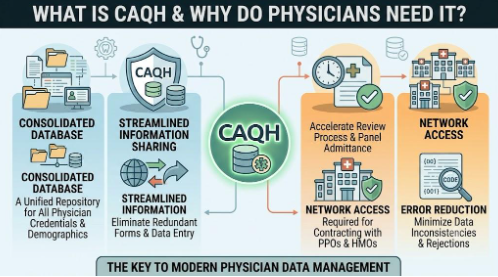
CAQH stands for Council for Affordable Quality Healthcare. CAQH operates the CAQH Provider Data Portal, which allows healthcare providers to maintain professional and practice information and share that information with participating health plans and other authorized organizations.
Instead of repeatedly providing the same information to different organizations, physicians can maintain a centralized profile containing important professional and practice details. The CAQH Provider Data Portal can be used for purposes including credentialing, provider directories, and other administrative processes.
Why Do Physicians Need CAQH?
Physicians often need to provide similar information to multiple health plans during credentialing or other administrative processes. Without a centralized system, providers could spend considerable time completing similar paperwork repeatedly.
CAQH helps reduce this duplication by allowing physicians to maintain their information in one profile and authorize participating organizations to access it.
What Information Goes Into a CAQH Profile?
A physician's CAQH profile can contain a significant amount of professional and practice information.
Depending on the provider and the requirements of participating organizations, this may include:
- Personal information
- Education
- Medical training
- Licenses
- Board certifications
- Work history
- Practice locations
- Hospital affiliations
- Professional liability insurance
- Malpractice information
- Professional references
- Provider identifiers
- Practice information
- Supporting documentation
The exact information required can vary depending on the provider's circumstances and the organizations requesting access to the information.
How Does CAQH Work?
The basic CAQH process is fairly straightforward.
Step 1: Register
The physician or authorized staff member creates or accesses the provider profile.
Step 2: Complete the Profile
The physician enters the requested professional and practice information.
This can include education, training, licenses, work history, practice locations, and other information relevant to credentialing.
Step 3: Upload Supporting Documents
Required documents can be uploaded to support the information included in the profile.
Examples may include licenses, certificates, malpractice documentation, and other professional records.
Step 4: Review the Information
Before submitting or attesting, the physician should carefully review the entire profile.
Even a small error in an address, license date, employment history, or other information can create additional questions or delays.
Step 5: Authorize Health Plans
Physicians can authorize participating organizations to access their information for appropriate purposes.
Step 6: Attest to the Information
The physician confirms that the information provided is accurate and complete.
Step 7: Keep the Profile Updated
CAQH is not a one-time task.
Physicians need to maintain their information and respond to requests when updates or re-attestation are required. CAQH's provider guide outlines the process as registering, completing the application, reviewing the profile, authorizing organizations, attesting, and uploading supporting documentation.
What Happens If Your CAQH Profile Is Incomplete?
An incomplete or outdated profile can create additional administrative work. For example, suppose a physician changes practice locations but does not update the information in the profile. A health plan may have outdated information when reviewing the provider.
Similarly, missing documents or inconsistent information may result in requests for clarification or additional documentation.
These issues can slow down the overall credentialing workflow. That is why physicians should treat their CAQH profile as an ongoing administrative responsibility rather than something they complete once and forget.
CAQH vs. Provider Enrollment
CAQH and provider enrollment are also related but different. Credentialing generally focuses on verifying a provider's qualifications.
Provider enrollment involves establishing the provider's participation with a payer so the provider can be recognized within the payer's system and, where applicable, submit claims under the appropriate enrollment arrangement. A physician may therefore encounter several administrative steps that happen alongside one another.
Understanding these differences can prevent confusion during onboarding.
Why Accuracy Matters in CAQH
Imagine a physician's profile contains an old license expiration date, or the physician recently moved to a new office but the old practice address remains in the profile. Small inconsistencies like these can create confusion for a health plan reviewing the provider. Physicians should regularly review important details such as:
- License information
- Practice locations
- Contact information
- Employment history
- Hospital affiliations
- Board certification
- Malpractice coverage
- Education and training
- Professional identifiers
CAQH and Revenue Cycle Performance
Revenue-cycle performance depends on many processes working together. Claims need to be submitted correctly, payments need to be posted accurately, denials need to be addressed, and outstanding balances need to be followed up. Provider information is part of that larger process.
For a broader look at how practices can use financial metrics to evaluate billing performance, see Qiaben's Top Wound Care Billing Metrics Every Physician Should Know.
Although the article focuses on wound care, the general concepts of monitoring claim performance, denials, A/R, and collections can be useful across many healthcare practices.
Can a Practice Manage CAQH for Its Physicians?
Yes. Practice administrators and authorized staff can assist physicians with gathering information and managing administrative tasks.
For practices with multiple physicians, having a standardized process can make credentialing easier.
A practice might maintain a credentialing checklist covering:
- CAQH status
- License expiration dates
- Board certification
- Malpractice coverage
- NPI information
- Practice locations
- Payer applications
- Enrollment status
- Recredentialing dates
This can help prevent important deadlines from being overlooked.
Should Physicians Handle Credentialing Themselves?
Some physicians and small practices manage credentialing internally. However, credentialing can become time-consuming when a practice works with multiple insurance companies or has several providers. There may be applications to prepare, documents to collect, information to verify, payer portals to monitor, and follow-ups to complete.
In these situations, professional physician credentialing services can help practices organize the process, manage documentation, monitor application status, and keep important provider information on track.
The goal is not simply to complete a CAQH profile. It is to build a reliable credentialing process that continues to work as the practice grows.
Final Thoughts
CAQH plays an important role in helping physicians maintain and share professional and practice information with participating healthcare organizations. However, CAQH should not be confused with credentialing itself. A complete CAQH profile can support the credentialing process, but each health plan still has its own requirements and review process. The best approach is to keep information accurate, maintain supporting documents, monitor important expiration dates, and start credentialing activities early.
At Qiaben, we're committed to helping healthcare providers simplify medical billing and revenue cycle management. Explore more expert insights on our blog, and if you have questions or need support with your billing processes, get in touch with our team.