
The Difference Between a Coding Error and a Documentation Problem
09/08/2026 6 min read
When a medical claim is denied, it is easy to say, "There was a coding error." But that is not always the case. Sometimes the code is wrong. Other times, the code may be correct, but the medical record does not contain enough information to support it.
These are two different problems:
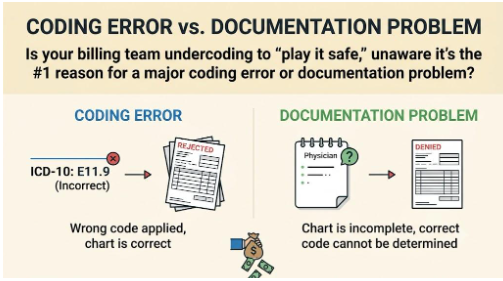
A coding error happens when the wrong code is selected or submitted.
A documentation problem happens when the medical record does not provide enough information to support the correct code.
Knowing the difference can help your practice fix the real problem instead of repeatedly correcting the same claim.
What Is a Coding Error?
A coding error occurs when the code submitted on a claim does not correctly represent the service or diagnosis documented in the patient's medical record. For example, a provider performs a specific procedure, but the coder selects a different CPT code.
Other common coding errors include:
- Choosing the wrong CPT code
- Selecting the wrong diagnosis code
- Using an outdated code
- Missing a required modifier
- Using an incorrect modifier
- Reporting a service that was not documented
- Using a code that does not match the patient's diagnosis
- Incorrectly applying coding guidelines
Even a small coding mistake can cause a claim to be delayed, rejected, or denied.
Example of a Coding Error
Imagine a provider documents a procedure correctly in the patient's record. The documentation clearly supports the service, but the coder selects the wrong CPT code when preparing the claim. In this situation, the documentation is not the problem.
What Is a Documentation Problem?
A documentation problem is different. Here, the coder may know which code should be used, but the medical record does not contain enough information to support that code. For example, a provider may perform a service but fail to document important details about what was done.
The coder cannot simply guess the missing information.
Common documentation problems include:
- Missing procedure details
- Incomplete physician notes
- Missing diagnosis information
- Lack of medical necessity details
- Missing signatures
- Unclear descriptions of services
- Missing information needed to support a higher-level service
- Incomplete treatment records
In these situations, the provider may need to clarify or complete the documentation before the claim can be coded correctly.
1. The Code Does Not Match the Documentation
This is a common coding error. Suppose the medical record clearly describes a particular procedure, but the claim contains a different CPT code. The documentation may be complete, but the wrong code was chosen.
What to do:
The coding team should review the medical record, compare it with the submitted code, and correct the code before resubmitting the claim.
Regular coding reviews can help identify whether the same mistake is happening repeatedly.
2. The Documentation Does Not Support the Code
Now consider the opposite situation. The coder selects a code that could be appropriate, but the medical record does not provide enough information to support it. For example, the record may mention that a procedure was performed but fail to include important details required to support the selected code.
This is a documentation problem.
What to do:
The practice should identify what information is missing and work with the provider to improve documentation. The goal should not be to add information simply to justify a higher-paying code. Documentation should accurately describe the care that was actually provided.
3. Missing Modifiers: Which Problem Is It?
Modifiers can make this situation slightly more complicated. If the documentation clearly supports the use of a modifier, but the coder forgets to include it, that is generally a coding problem. However, if the documentation does not explain the circumstances needed to support the modifier, the issue may be a documentation problem.
This is why coding teams need to review both the code and the supporting documentation.
Qiaben's guide on CPT coding accuracy also explains the importance of proper documentation, modifier use, updated CPT codes, and checking codes before claim submission. It is a useful resource for practices that want to better understand how CPT coding affects billing accuracy.
4. Outdated Codes Are Coding Problems
Medical codes can change over time. If a coder uses an outdated CPT code instead of the current code, the issue is a coding error. The medical record may be completely accurate. The problem is that the wrong version of the code was used.
How to prevent it:
- Keep coding resources updated
- Review annual coding changes
- Train coding staff regularly
- Update coding software when required
- Review frequently used codes
Keeping coding knowledge current can help reduce avoidable claim problems.
5. Missing Information Is a Documentation Problem
Sometimes the coder cannot complete the claim because important information is simply not present. For example, the provider may document that a patient received treatment but fail to explain enough about the service, diagnosis, or medical necessity.
The coder should not make assumptions. Instead, the practice may need to clarify the documentation with the provider.
Why this matters
Good documentation gives coders the information they need to report services accurately.
It also provides support if an insurance company questions the claim later.
Why These Problems Cause Revenue Loss
Both coding errors and documentation problems can affect a practice's revenue.
A problem may lead to:
- Claim denials
- Claim rejections
- Payment delays
- Incorrect reimbursement
- Additional claim follow-up
- Increased administrative work
- Compliance concerns
One incorrect claim may not seem significant. But if the same problem affects hundreds of claims, the financial impact can become much larger.
This is why practices should look for patterns rather than simply correcting individual claims.
How Medical Coding Services Can Help
For busy practices, reviewing every coding and documentation issue internally can be difficult. Professional medical coding services can help practices review medical records, identify coding issues, check code accuracy, and find patterns that may be affecting claims.
External coding support can also give practices another layer of quality review. Instead of only fixing errors after a denial, regular reviews can help identify problems earlier. The goal is simple: make sure the services provided, the documentation recorded, and the codes submitted all tell the same story.
Final Thoughts
A coding error and a documentation problem may look similar when a claim is denied, but they are not the same thing. A coding error means the information may be available, but the wrong code was selected or submitted. A documentation problem means the information needed to support the correct code may be missing or unclear. Understanding this difference helps practices find the real cause of claim problems.
At Qiaben, we're committed to helping healthcare providers simplify medical billing and revenue cycle management. Explore more expert insights on our blog, and if you have questions or need support with your billing processes, get in touch with our team.