20 posts tagged with "medical-billing-service"

View All Tags

Empower Growth with Trusted Physician Credentialing Service

· 6 min read
Qiaben Health

In today’s fast-paced healthcare environment, efficiency and compliance are key to success. One essential process that often goes unnoticed but holds massive importance is physician credentialing. Without it, providers can’t practice or get paid. That’s why physician credentialing services have become a cornerstone in streamlining healthcare operations and ensuring regulatory compliance.

What Is Physician Credentialing?

physician credentialing

Physician credentialing involves the thorough verification of a healthcare provider’s background, including their education, professional training, licenses, and employment history. Insurance companies, hospitals, and healthcare facilities use this information to ensure that doctors are properly certified and eligible to deliver care.

Without proper credentialing, physicians cannot legally provide services to insured patients. In other words, they can’t get reimbursed by payers, which directly affects the financial health of the practice.

Why Is Credentialing So Important?

Let’s consider a simple scenario. A new physician joins a practice. Everyone is ready to go, but the insurance companies haven’t approved the provider yet. What happens? Claims get denied. Payments are delayed. And revenue takes a hit.

That’s where professional physician credentialing service providers come in. They make sure this process is handled quickly and correctly, so there are no interruptions in billing or patient care.

Click here

Common Credentialing Challenges

Credentialing might sound simple, but it comes with its share of headaches. From paperwork to strict deadlines, a lot can go wrong. Some common challenges include:

  • Missing or inaccurate documents
  • Delayed responses from licensing boards
  • Failure to meet payer-specific requirements
  • Resubmissions due to minor errors

These delays can stall revenue and even damage a provider’s reputation. A reliable credentialing team can help avoid these pitfalls by handling the process with accuracy and speed.

The Role of Medical Billing in Credentialing

Lorem ipsum dolor sit amet, consectetur adipiscing elit. Ut elit tellus, luctus nec ullamcorper mattis, pulvinar dapibus leo.

Credentialing doesn’t happen in isolation. It’s closely tied to medical billing services. If a provider isn’t credentialed, billing teams can’t submit claims. This creates a backlog that leads to delayed or lost revenue.

Billing and credentialing must work hand-in-hand. A provider who is properly credentialed will face fewer claim rejections, resulting in a smoother revenue cycle. That’s why practices often prefer firms that offer both services under one roof.

How Credentialing Works: Step-by-Step

Understanding the steps involved helps you see the full picture. Here’s how physician credentialing typically unfolds:

1. Gather Provider Info

Education, licensure, certifications, DEA registration, and malpractice insurance.

2. Application Submission:

This includes applications to insurance companies, hospitals, and networks.

3. Primary Source Verification

All credentials are verified directly with the source (e.g., medical schools, licensing boards).

4. Follow-Up

The credentialing team follows up on pending documents and approvals.

5. Approval and Enrolment

 Once verified, the provider is enrolled in insurance panels and can begin billing.

Why Outsourcing Credentialing Is Smart

Many practices try to handle credentialing in-house. However, it’s often more time-consuming than expected. Staff may not have the training to manage strict deadlines or changing payer rules. This is why outsourcing to a physician credentialing service can save time, reduce errors, and speed up onboarding.

Professional credentialing companies stay up to date on the latest compliance rules. They also use credentialing software and automation tools to streamline the process. This results in fewer delays and better outcomes for healthcare providers.

Benefits of Using Physician Credentialing Services

The benefits go far beyond just saving time. Here’s why using credentialing services makes sense:

  • Faster Insurance Approvals

    Accelerated payer enrolment means quicker revenue generation.

  • Reduced Errors

    Fewer rejections or denials due to incorrect paperwork.

  • Focus on Patient Care

    Physicians can concentrate on clinical duties while experts handle administrative work.

  • Regulatory Compliance

    Keeps your practice aligned with state and federal regulations.

Credentialing isn’t a one-time task. It requires regular updates and renewals, which can be easily managed by experts

Integration with Medical Billing Services

Credentialing and billing are two sides of the same coin. When these services are integrated, your practice benefits from:

  • Better communication between credentialing and billing teams
  • Real-time updates on provider statuses
  • Improved cash flow from clean claims
  • Centralized documentation and record keeping

By combining medical billing services with credentialing, practices get a seamless experience. This ensures no gaps in the revenue cycle and faster onboarding of new providers.

Physician Credentialing for Group Practices and Hospitals

Credentialing becomes even more critical when it involves multiple providers. Group practices and hospitals must manage credentialing for dozens or even hundreds of professionals. Each provider may deal with different payers, specialties, or states.

Professional credentialing services bring scalability. They offer structured systems that manage large volumes of applications while ensuring each step is accurate and timely.

physician credentialing

Avoiding Revenue Loss from Credentialing Delays

Credentialing delays can directly affect your bottom line. Every day a provider isn't credentialed is a day your practice loses money. Worse, it can lead to denied claims that require time-consuming rework.

With an experienced physician credentialing service, these risks are greatly reduced. Practices can expect consistent cash flow, improved provider satisfaction, and fewer billing issues.

Final Thoughts

In today’s healthcare world, every detail matters. From patient care to back-office operations, each part plays a role in overall success. Credentialing may seem like a behind-the-scenes task, but it has a front-line impact.

By using a trusted provider for physician credentialing services, your practice can ensure compliance, avoid billing disruptions, and speed up onboarding for new providers. Partnering with effective medical billing services makes the impact even greater. Make credentialing a priority. Because when it’s done right, everything else runs smoother.

CPT Codes in Medical Billing: Everything You Need to Know

· 5 min read
Qiaben Health

Medical billing services play a crucial role in the healthcare industry. One of the key components of this process is the use of Current Procedural Terminology (CPT) codes. These standardized codes help providers communicate with payers to ensure accurate reimbursement for services rendered. Additionally, understanding how CPT codes work can significantly improve billing efficiency and reduce claim denials.

cpt codes

What Are CPT Codes?

CPT codes are a standardized set of medical codes used by healthcare professionals, hospitals, and laboratories. These codes describe medical, surgical, and diagnostic services provided to patients. The American Medical Association (AMA) introduced these codes in 1966 to streamline the reporting of procedures.

Every year, the AMA updates the CPT code set to reflect advancements in medical services. These updates include new codes, revised descriptions, and deleted codes to maintain accuracy. Therefore, staying updated with these changes is essential for smooth medical billing services.

Structure of CPT Codes

CPT codes consist of five characters, mostly numerical. However, some codes have an alphanumeric fifth character, such as F, T, or U. These codes eliminate subjective interpretation and create uniformity in medical billing.

For example:

  • 33275: Transcatheter removal of a leadless pacemaker

  • 3006F: Documentation and review of chest X-ray results

  • 0510T: Removal of sinus tarsi implant

  • 0079U: DNA analysis for specimen identity verification

Categories of CPT Codes

To simplify usage, the AMA divides CPT codes into three main categories.

1. Category I Codes

These are the most commonly used CPT codes. They represent services widely performed in medical settings, including:

  • Evaluation and Management (99202–99499)

  • Anaesthesia (00100–01999)

  • Surgery (10004–69990)

  • Radiology (70010–79999)

  • Pathology and Laboratory (80047–89398)

  • Medicine (90281–99607)

2. Category II Codes

These codes, ending in “F,” are supplementary tracking codes used for performance measurement. They help providers document quality care but are not used for reimbursement.

3. Category III Codes

These temporary codes, ending in “T,” describe emerging and experimental procedures. Eventually, if a procedure gains FDA approval and widespread use, it may be upgraded to a Category I code.

CPT Coding Guidelines

Understanding CPT coding guidelines is essential for accurate medical billing. These guidelines provide instructions on how and when to assign codes correctly. They also clarify which codes can be reported together and which cannot.

Key aspects of CPT coding guidelines include:

  • Code Descriptions: Each CPT code has a specific description that must match the documented procedure.
  • Bundling Rules: Some codes are bundled together and should not be reported separately.
  • Unlisted Procedures: If no existing code describes a procedure, an unlisted code should be used.
  • Global Surgical Package: Some surgical codes include pre-operative, intra-operative, and post-operative care.

Before assigning codes, medical coders must review the guidelines in each section of the CPT codebook to ensure compliance and prevent claim rejections.

Click here

The Role of CPT Codes in Medical Billing Services

Accurate CPT coding ensures that healthcare providers receive proper reimbursement. Medical billing professionals use these codes to submit insurance claims. However, a single incorrect code can lead to claim denials, delayed payments, or audits.

To avoid errors, billers must:

  • Stay updated with annual CPT code changes

  • Follow CPT coding guidelines

  • Understand payer-specific coding requirements

CPT Modifiers in Medical Billing

Modifiers provide additional details about a procedure. They consist of two numbers, two letters, or a combination of both. Modifiers indicate variations in the procedure, such as:

  • Right or left side of the body

  • Multiple procedures in one session

  • Increased complexity or time required

As a result, modifiers enhance claim accuracy and ensure correct reimbursement.

CPT vs. Other Medical Code Sets

CPT codes are just one part of medical billing. Other essential coding systems include:

  • HCPCS Level II Codes: Used for reporting supplies, equipment, and non-physician services

  • ICD-10-CM Codes: Used to describe patient diagnoses

  • ICD-10-PCS Codes: Used for inpatient hospital procedures

Together, these systems ensure complete and accurate medical claims.

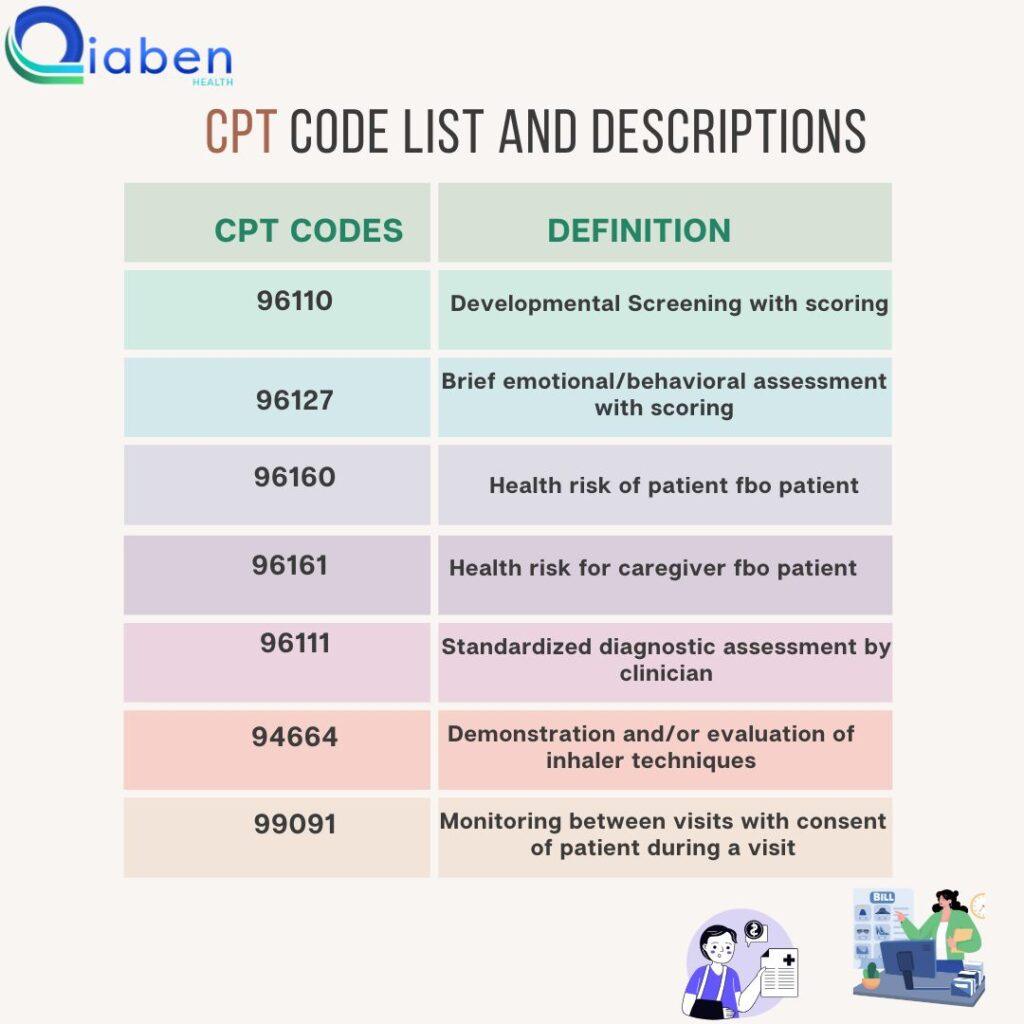
Here’s a table listing common CPT codes and what they cover:
CPT CodeDescription
99202-99499Evaluation and Management (E/M) services
00100-01999Anaesthesia services
10004-69990Surgical procedures
70010-79999Radiology procedures (e.g., X-rays, MRIs, CT scans)
80047-89398Pathology and Laboratory services
90281-99607Medicine services, including immunizations and injections
11042Debridement of subcutaneous tissue
17000Destruction of skin lesion
36415Routine blood draw (venipuncture)
45378Diagnostic colonoscopy
70450CT scan of the head without contrast
93306Echocardiography (heart ultrasound)
99213Established patient office visit (level 3)
90791Psychiatric diagnostic evaluation
99072Additional supplies/staff time during a public health emergency
G0463Hospital outpatient clinic visit (Medicare-specific code)

Ensuring Compliance and Accuracy in Medical Billing Services

  • Medical coders and billers must follow strict guidelines to maintain compliance. Best practices include:

    • Using the most current CPT code book

    • Following payer-specific coding policies

    • Attending regular coding training sessions

    • Double-checking claims for errors before submission

    By doing so, practices can reduce denials and speed up reimbursement.

    for errors before submission.

Conclusion

CPT codes are an essential part of medical billing services. They standardize medical procedures and ensure accurate documentation and reimbursement. Ultimately, by understanding the structure, categories, and importance of CPT codes, healthcare providers and billing professionals can improve efficiency, minimize claim denials, and maintain compliance in medical billing practices.

Female Dental Doctor

How to Optimize Mid Revenue Cycle Services for More Profit

· 5 min read
Qiaben Health

How to Optimize Mid Revenue Cycle Services for More Profit

mid revenue cycle services

The mid revenue cycle plays a critical role in ensuring financial success in healthcare. It covers medical coding, charge capture, clinical documentation improvement (CDI), and claim submissions. A well-optimized mid revenue cycle leads to fewer denials, improved cash flow, and better patient satisfaction. By refining these processes, healthcare providers can maximize revenue while maintaining compliance.

Understanding the Mid Revenue Cycle

The mid revenue cycle bridges the clinical and financial aspects of patient care. It ensures that services provided are accurately documented, coded, and billed. Any inefficiencies in this phase can lead to revenue leakage, claim denials, and compliance risks. Healthcare providers must adopt best practices to optimize this cycle and enhance profitability.

1. Strengthen Clinical Documentation Improvement (CDI)

Accurate clinical documentation is essential for proper reimbursement. Errors in documentation can lead to claim denials or underpayments. Implementing CDI programs helps ensure complete and precise patient records. Training physicians and coders to improve documentation quality is vital. Regular audits can identify gaps and improve documentation standards.

2. Enhance Medical Coding Accuracy

Medical coding is a crucial component of the mid revenue cycle. Errors in coding can result in claim denials or incorrect reimbursements. Investing in well-trained coders and continuous education ensures compliance with updated coding guidelines. Using advanced medical billing services with automated coding tools can enhance accuracy and efficiency.

3. Optimize Charge Capture Processes

Charge capture mistakes lead to lost revenue. Healthcare providers should implement robust charge capture systems to track all billable services. Automating charge capture can reduce manual errors and ensure accurate billing. Regular reconciliation of charges and services helps identify discrepancies early.

Click here

4. Improve Claims Management

Claim denials and rejections slow down revenue cycles. Healthcare facilities must focus on proactive claim management. Submitting clean claims the first time reduces the risk of delays. Medical billing services equipped with AI-driven tools can streamline the claims process. Identifying denial trends and addressing them proactively improves cash flow.

5. Leverage Medical Billing Services for Efficiency

Outsourcing medical billing services can enhance efficiency and profitability. Professional billing companies use advanced technology and expertise to minimize errors. They help manage claim submissions, follow-ups, and appeals effectively. This allows healthcare providers to focus on patient care while improving financial performance.

6. Conduct Regular Audits and Compliance Checks

Audits help identify revenue leakage and non-compliance issues. Regular internal and external audits ensure that coding and billing practices align with industry regulations. Compliance checks prevent legal risks and optimize reimbursements. Healthcare organizations should create a culture of continuous improvement to refine mid revenue cycle processes.

7. Utilize Data Analytics for Revenue Optimization

Data analytics provide valuable insights into revenue cycle performance. By analyzing trends, healthcare providers can identify inefficiencies and improve processes. AI-powered tools help forecast revenue, detect anomalies, and enhance decision-making. Integrating analytics into medical billing services improves accuracy and maximizes reimbursements.

8. Implement Advanced Technology and Automation

Technology plays a key role in optimizing the mid revenue cycle. Implementing AI-driven billing solutions, automated coding tools, and electronic health record (EHR) integrations enhances accuracy. Automation reduces manual errors, speeds up processes, and increases revenue collection efficiency. Investing in technology ensures a streamlined and error-free billing cycle.

9. Improve Staff Training and Communication

A well-trained staff is crucial for an optimized revenue cycle. Continuous training on medical billing services, coding updates, and compliance regulations enhances accuracy. Effective communication between billing teams, coders, and physicians prevents errors and ensures seamless operations. Encouraging teamwork leads to better financial outcomes.

10. Focus on Patient-Centred Billing

Transparent and patient-friendly billing improves collections and satisfaction. Providing clear billing statements, multiple payment options, and financial assistance programs enhances the patient experience. Engaging patients in the billing process reduces disputes and improves payment rates.

Best Practices for Mid-Revenue Cycle Improvement

Optimizing the mid-revenue cycle is just as critical as strengthening front- and back-end revenue cycle management. Implementing best practices can reduce denials, improve compliance, and maximize revenue capture.

Addressing Documentation Gaps

Research shows that more than half of medical charts require documentation improvements. Time constraints and gaps between medical terminology and coding standards are common obstacles. Clinical Documentation Improvement (CDI) programs help bridge these gaps by training clinicians and staff, ensuring that patient encounters translate into accurate coded data. Emerging tools like EHR scribe technology and AI-driven documentation are further enhancing CDI efficiency.

Enhancing Coding with Technology

Advanced tools like computer-assisted coding (CAC) and autonomous coding solutions are transforming medical coding. These technologies support coders by increasing accuracy, reducing turnaround times, and improving productivity. While AI offers significant support, human oversight remains critical to validate coding accuracy and maintain compliance.

Leveraging Technology and Training

Integrating AI and automation into the revenue cycle management workflow requires balance. Training staff to use these tools effectively ensures technology enhances performance rather than replacing human expertise. The most successful organizations combine technology with skilled staff to achieve long-term mid-cycle improvements.

Conclusion

Optimizing the mid revenue cycle is essential for financial success in healthcare. Strengthening CDI, improving coding accuracy, and leveraging medical billing services enhance efficiency. Automation, audits, and data analytics further drive profitability. By adopting these best practices, healthcare providers can reduce denials, increase revenue, and focus on quality patient care.

HIPAA Compliance Uncovered: The Ultimate Guide to Secure Medical Billing

· 3 min read
Qiaben Health

HIPAA Compliance Uncovered: The Ultimate Guide to Secure Medical Billing:

Introduction

In today’s digital era, securing patient data in medical billing is more critical than ever. The Health Insurance Portability and Accountability Act (HIPAA) establishes strict guidelines for handling protected health information (PHI). There is a risk of severe penalties, damage to one's reputation, and legal action if you don't follow the rules. This guide explores the essentials of HIPAA compliance in medical billing and how healthcare providers can ensure the security of patient information.

HIPAA Compliance Uncovered: The Ultimate Guide to Secure Medical Billing:

Understanding Medical Billing under HIPAA:

There are a few key rules in HIPAA that have an effect on medical billing practices:

Privacy Rule: Regulates the use and disclosure of PHI.
Security Rule: Establishes safeguards for electronic PHI (ePHI).
Enforcement Rule: Governs investigations and penalties for violations.
Breach Notification Rule: Mandates reporting of data breaches to affected parties and authorities.

Click here

Common HIPAA Compliance Challenges in Medical Billing:

Inadequate Data Security Measures: Many healthcare organisations lack secure storage for patient data, strong encryption, and firewall protections.
Lack of Employee Training: Staff unfamiliar with HIPAA regulations can unintentionally expose sensitive information.
Improper Data Sharing: Unauthorised sharing of PHI, whether intentional or accidental, is a major compliance risk.
Failure to Conduct Risk Assessments: Regular security assessments are necessary to identify and fix vulnerabilities.
Third-Party Vendor Risks: Billing service providers must also comply with HIPAA regulations to avoid indirect liability.

Best Practices for HIPAA-Compliant Medical Billing:

1.  Implement Strong Security Measures
  •      Encrypt all stored and  transmitted patient data.
  •     Use multi-factor authentication for system access.
  •     Regularly update software and security patches.
2.  Conduct Employee Training
  •   Staff should be taught about security procedures and HIPAA regulations.
  •   Educate  employees on recognising phishing and cyber threats.
  •   Limit PHI access based on job roles.
3.  Utilise Secure Billing Software
  •   Select billing platforms that comply with HIPAA and incorporate encryption.
  •   Ensure software vendors sign Business Associate Agreements (BAAs).
  •   Conduct periodic audits of billing system security.
4.  Regular Risk Assessments
  •   Perform HIPAA security risk assessments annually.
  •   Identify and address potential vulnerabilities.
  • Develop an incident response plan for data breaches.
5.  Clearly define data handling procedures
  •  Restrict PHI access to authorised personnel only.
  •  Avoid using personal devices to access patient data.
  • Implement strict data disposal procedures for old records.

Consequences of violating HIPAA Failure to adhere to HIPAA can result in:

  • Financial Penalties: Fines range from $100 to $50,000 per violation, with a maximum annual penalty of $1.5 million.
  • Repercussions from the law include lawsuits and criminal charges for willful neglect.
  • Patient dissatisfaction as a result of lost confidence in the healthcare provider.

Conclusion:

         HIPAA compliance in medical billing is unchangeable. To execute proper authentication and train the employee,  using HIPAA software to maintain proper exams and secure the patient information to neglect the rejections. Giving more  importance to compliance not only for maintaining patient information but also to boost the medical billing.

How to Secure Medical Billing Systems from Cyberattacks

· 6 min read
Qiaben Health

cyber hacking

Introduction

Medical billing systems are the financial heartbeat of healthcare—powering claim submission, reimbursements, patient eligibility checks, and more. But their critical role also makes them prime targets for cyberattacks. Securing revenue cycle management (RCM) is no longer optional; it's essential for financial health, patient trust, and operational continuity.

Why Cybersecurity Matters in Medical Billing

Medical billing is an essential part of healthcare operations. It involves handling patient records, insurance claims, and financial transactions. A cyberattack can disrupt these processes, leading to serious consequences.

Key Reasons to Strengthen Cyber Defence:

Protect Patient Data: Billing systems store personal and financial details. A breach can expose sensitive Information.

Ensure Regulatory Compliance: Healthcare providers must follow HIPAA and other security regulations.
 Prevent Financial Losses: Cyberattacks can lead to fraudulent claims, lost revenue, and penalties.

 Maintain Trust: Patients expect their data to be secure. A breach can harm a provider’s reputation.

With increasing cyber threats, healthcare organizations must take proactive security measures.

Click here

Common Cyber Threats in Medical Billing

Medical billing systems face several cybersecurity risks. Understanding these threats helps providers implement better defences.

  1. Phishing Attacks

Hackers send fraudulent emails or messages to steal login credentials. Employees may unknowingly click on malicious links, giving hackers access to billing systems.

  1. Ransomware

This type of malware encrypts data and demands payment for its release. If a billing system is affected, it can disrupt operations and lead to financial losses.

  1. Data Breaches

Unauthorized access to patient records can occur due to weak security controls. Stolen data may be sold on the dark web or used for fraudulent activities.

  1. Insider Threats

Employees or third-party vendors with access to billing systems may intentionally or unintentionally compromise data security.

  1. Outdated Software & Systems

Unpatched software can have security vulnerabilities that hackers exploit. Keeping systems updated is crucial for cybersecurity.

  1. Lack of Multi-Factor Authentication (MFA)

Weak or reused passwords make it easier for hackers to access billing accounts. MFA adds an extra layer of protection.

Core Principles for Defending Medical Billing Systems

1. Adopt a Defense-in-Depth Security Strategy

Leverage layers like network segmentation, intrusion detection, firewalls, and endpoint protection to prevent lateral movement and contain breaches.

2. Strict Access Control & Identity Management

Implement least privilege access and enforce multi-factor authentication (MFA) to neutralize unauthorized access—even from compromised credentials. 

3. Encrypt Data at Rest and in Transit

Ensure all billing data is encrypted, both in storage and during transmission, to render stolen data unreadable and mitigate breach damage.

4. Reliable, Immutable Backups

Maintain immutable (tamper-proof) backups.To counter ransomware, ensure backups are offline and recoverable even if primary systems are compromised. 

5. Rigorous Vendor Risk Management

Since many organizations outsource RCM, it's vital to vet third-party vendors for cybersecurity maturity—HIPAA compliance, SOC 2/ISO 27001 certifications, BAAs, audits, and incident response plans are non-negotiable. 

6. Keep Systems Patched & Up-to-Date

Unpatched systems are open invitations to attackers. Automate patch deployment across billing software and dependent infrastructure. 

7. Security Awareness & Human Vigilance

A robust security culture is essential. Regular phishing simulations, training, and protocols help staff identify and respond to threats before they escalate. 

8. Continuous Audits & Risk Assessments

Regularly evaluate your cyber posture and perform vulnerability scans. Engage trusted third-party auditors to ensure objectivity. 

9. Threat Detection & Rapid Response Frameworks

Use advanced monitoring tools such as EDR (Endpoint Detection and Response) and XDR (Extended Detection and Response) to monitor anomalies, isolate threats swiftly, and initiate incident response. (AMN HealthcareGuidehouse)

10. Business Continuity & Downtime Planning

Plan for disruptions by establishing downtime committees and recovery mechanisms. Smaller practices should clarify emergency protocols with their billing vendors—possibly including secured loans or alternative workflows. (ACS)

Compliance & Regulatory Considerations

Healthcare providers must comply with cybersecurity regulations to avoid legal penalties.

  1. HIPAA (Health Insurance Portability and Accountability Act)

HIPAA requires healthcare organizations to safeguard patient data and implement security measures. Failure to comply can result in heavy fines.

  1. PCI DSS (Payment Card Industry Data Security Standard)

If billing systems process credit card payments, they must comply with PCI DSS to protect financial transactions.

  1. NIST Cybersecurity Framework

This framework provides guidelines for managing cybersecurity risks effectively. Healthcare providers can use it to strengthen security policies.

Following these regulations ensures better protection against cyber threats and builds patient trust.

With evolving technology, healthcare cybersecurity is also advancing. Here are some key trends shaping the future of medical billing security:

  1. AI-Powered Threat Detection

Artificial Intelligence (AI) can detect suspicious activities in real time, reducing response time to cyber threats.

  1. Blockchain for Secure Transactions

Blockchain technology can enhance security in billing and insurance claims by preventing fraud and unauthorized modifications.

  1. Biometric Authentication

Fingerprint or facial recognition login methods will replace traditional passwords, making unauthorized access more difficult.

  1. Cloud-Based Security Solutions

More healthcare providers are moving to cloud-based EHR and billing systems with built-in cybersecurity features.

Adopting these innovations will help healthcare organizations stay ahead of cybercriminals.

cyber security

Conclusion

Securing medical billing systems is not just a necessity—it’s a responsibility. Cyber threats are constantly evolving, and healthcare providers must strengthen their defences.

By implementing strong security measures, training staff, and staying compliant with regulations, medical billing can remain secure. Patients trust healthcare providers with their data and protecting that trust should be a top priority.

Medical Billing Business: How to Get Started the Right Way

· 7 min read
Qiaben Health

Medical Billing Business: How to Get Started the Right Way

medical billing company

Introduction

Starting a medical billing business can be a promising venture if you plan carefully and develop a systematic approach. In today’s competitive healthcare environment, reliable billing practices can make all the difference to providers and patients alike. In this post, we will explore the foundations of setting up your medical billing business for success. You will learn essential steps, best practices, and practical advice for establishing a strong foothold in the industry. With clarity and actionable tips, this guide is perfect for aspiring entrepreneurs and seasoned healthcare professionals looking to diversify their services.

Medical billing involves processing claims, handling payments, and ensuring healthcare providers get paid on time. However, setting up a successful business requires careful planning. This guide will walk you through the steps to start your medical billing business the right way.

Understanding the Industry

Before launching your business, it is important to understand the medical billing industry in its entirety. The world of healthcare billing is constantly evolving. Providers depend on accurate billing to ensure proper revenue cycle management. It is a field that requires strict adherence to privacy rules and regulations. Additionally, technology plays a major role in achieving error-free billing and claims submissions. Therefore, investing in updated software and training can reduce mistakes and speed up claims processing. Moreover, a deep industry understanding will help you connect with healthcare professionals who are eager to collaborate.

Crafting Your Business Plan

A solid business plan forms the foundation of any successful venture. Start by outlining your services, target audience, and goals. Identify your market niche. Are you aiming at small clinics or large hospitals? By doing so, you can target your marketing efforts more precisely. A well-prepared plan also includes budgeting and cash-flow management. This strategic document not only maps out your journey but will serve as a roadmap during uncertain times. In turn, having a detailed plan increases your chances of securing investments or loans to kickstart your enterprise.

Acquiring the Right Tools and Training

Invest in the essential technologies and develop expertise to run your billing operations smoothly. Modern software solutions can streamline the billing process, reduce errors, and improve overall efficiency. Training is equally essential. If you or your team members are new to healthcare billing, enroll in accredited courses that cover the nuances of coding, compliance, and claims management. Hands-on workshops and online tutorials can also offer practical knowledge. By investing in both technological and professional development, you set a foundation for continuous improvement and customer satisfaction.

Understanding the legal landscape is crucial in the medical billing business. Regulatory requirements such as the Health Insurance Portability and Accountability Act (HIPAA) guide how you manage patient information. To ensure compliance, you must invest in secure software and maintain robust data protection policies. Additionally, registering your business with the right agencies and obtaining the necessary licenses prevents future complications. It is a good practice to consult legal professionals who specialize in healthcare. This will help you navigate the complex legal terrain and allow you to focus on providing excellent billing services.

Click here

Building a Strong Team

A successful billing business relies on a dedicated team that understands the intricacies of the healthcare ecosystem. Hiring experienced billing specialists, coders, and customer service representatives is key. Equally important is ensuring that your team stays updated on the latest industry changes and technology advancements. Regular training sessions and team-building activities can bolster performance and ensure efficient operations. Remember that a collaborative work environment can foster quick problem solving and innovation. Together, a skilled team can drive your business to new heights.

Marketing Your Business

Marketing is a critical aspect of any venture, including medical billing. A well-rounded marketing strategy will help your business gain visibility in a competitive market. Start by developing an attractive website with clear information about your services. Leverage social media platforms to engage with potential clients and share industry insights. Additionally, consider content marketing by writing blog posts, hosting webinars, and offering free resources that educate healthcare providers. Using digital marketing techniques and search engine optimization (SEO), you can attract organic traffic and build trust over time.

Managing Finances and Cash Flow

Financial management is a common challenge in any new business. Develop a clear and realistic budget that accounts for software expenses, salaries, marketing, and other operational costs. It is essential to keep a close eye on your cash flow. Doing so can help you navigate challenges and ensure that you have enough funds to run operations smoothly. Consider integrating financial management software to monitor expenses and revenues closely. Keeping your books accurate will also help when you need to secure additional funding or demonstrate your business’s growth to potential investors.

Establishing Partnerships and Networks

Building strong relationships in the healthcare community can offer long-lasting benefits for your billing business. Forming strategic partnerships with hospitals, clinics, and other healthcare providers can help you secure a steady stream of clients. Attending industry conferences, participating in local business associations, and joining online forums are effective ways to create valuable connections. Furthermore, networking provides opportunities to exchange ideas, learn about emerging trends, and establish yourself as an authority in the field. These partnerships can lead to referrals and open doors to new business prospects.

Emphasizing Customer Service and Quality

A key ingredient for success in any service business is exceptional customer service. Your billing business should prioritize clear communication, swift problem resolution, and personalized attention. By addressing client concerns promptly, you build trust and encourage long-term collaboration. Monitoring your performance through client feedback and regular quality checks can highlight areas for improvement. In today’s competitive market, word-of-mouth and online reviews can significantly affect your reputation. Therefore, striving for quality in every transaction will not only satisfy your clients but also attract new opportunities over time.

Staying Adaptive and Future-Focused

The world of healthcare billing is in constant flux due to changes in regulations and technology. To remain competitive, your business must be agile and future focused. Regularly update your procedures, embrace new software solutions, and stay informed on policy changes. Research emerging trends such as artificial intelligence and automation in billing tasks. By anticipating shifts in the industry, you can adjust your strategy and maintain an edge over competitors. Continuous learning and innovation are key to evolving with the market and ensuring long-term success.

Conclusion

In summary, launching a medical billing business the right way involves a balanced blend of careful planning, technological investment, regulatory compliance, and market strategy. Starting with a clear business plan, you can set defined goals and strategies for reaching them. Gradually, investing in the right tools, team, and partnerships will create a strong operational backbone. Meanwhile, constant attention to customer service and quality keeps your clients satisfied and loyal. Finally, staying adaptive to industry trends ensures that your business remains relevant in a dynamic healthcare environment. By following these steps, you can pave the way for a successful and sustainable billing enterprise.

Dental Insurance Verification Made Easy: A Step-by-Step Guide

· 8 min read
Qiaben Health

Dental insurance verification is a critical process that ensures smooth claims processing, minimizes denials, and maximizes revenue for dental practices. With insurance policies evolving, dental offices must implement best practices to streamline verification procedures. This guide provides an updated approach to dental insurance verification in 2025 to improve efficiency and enhance profitability.

Why Dental Insurance Verification Matters

Insurance verification is more than just checking if a patient is covered. It helps:

  • Reduce claim denials and payment delays.
  • Provide patients with accurate treatment cost estimates.
  • Enhance the patient experience by preventing unexpected out-of-pocket expenses.
  • Improve cash flow by ensuring timely payments.
  • Minimize the administrative burden on staff by reducing follow-up on unpaid claims.

dental insurance

Step-by-Step Dental Insurance Verification Process

1. Collect Accurate Patient Information

Gathering comprehensive details from new and returning patients is the first step in ensuring accurate verification. Request:

  • Full name and date of birth
  • Policyholder’s name (if different from the patient)
  • Insurance provider name and contact details
  • Group and policy number
  • Employer details (if applicable)

Encourage patients to bring their insurance card to every appointment to ensure up-to-date information.

2. Verify Coverage Before the Appointment

Waiting until the day of the visit can cause unnecessary delays and claim rejections. Contact the insurance company at least 48 hours in advance via:

  • Online provider portals
  • Direct phone calls to the insurance carrier
  • Third-party verification services

By verifying coverage ahead of time, dental offices can proactively address issues before the patient arrives.

3. Confirm Covered Services and Limitations

Insurance policies vary widely. To avoid billing issues, check:

  • Annual maximums and remaining benefits
  • Deductibles and co-pays
  • Covered and excluded procedures
  • Frequency limitations (e.g., two cleanings per year)
  • Waiting periods for specific treatments
  • Whether the provider is in-network or out-of-network

4. Understand Coordination of Benefits (COB)

If a patient has dual insurance coverage (e.g., through a spouse’s plan), determine:

  • Which plan is primary and secondary
  • How benefits will be coordinated to maximize coverage

This prevents claims from being denied due to incorrect billing sequences.

5. Check for Pre-Authorization Requirements

Many insurance plans require pre-authorization for major dental procedures like crowns, implants, and orthodontics. Submitting pre-authorization requests in advance helps prevent denied claims and sets realistic expectations for the patient regarding their financial responsibility.

6. Confirm Reimbursement Rates

PPO contracts and reimbursement rates often change. Ensure that your practice is maximizing reimbursement by:

  • Negotiating better contract terms.
  • Reviewing fee schedules annually.
  • Understanding how to optimize billing for higher insurance payouts.

7. Document Everything

PPO contracts and reimbursement rates often change. Ensure that your practice is maximizing reimbursement by:

  • Negotiating better contract terms.
  • Reviewing fee schedules annually.
  • Understanding how to optimize billing for higher insurance payouts.

8. Educate Patients on Their Benefits

Transparent communication with patients regarding their coverage helps build trust and minimizes billing disputes. Provide written estimates of patient responsibility before beginning treatment. Offer a printed breakdown of covered services and out-of-pocket costs.

9. Implement Automated Verification Systems

Transparent communication with patients regarding their coverage helps build trust and minimizes billing disputes. Provide written estimates of patient responsibility before beginning treatment. Offer a printed breakdown of covered services and out-of-pocket costs.

10. Regularly Review Insurance Policies

Transparent communication with patients regarding their coverage helps build trust and minimizes billing disputes. Provide written estimates of patient responsibility before beginning treatment. Offer a printed breakdown of covered services and out-of-pocket costs.

dentist

Understanding PPO and DMO in Dental Insurance

What is a PPO (Preferred Provider Organization)?

A PPO dental plan allows patients to choose from a network of preferred dentists who have agreed to provide services at lower rates. Key features include:

  • Flexibility: Patients can visit any dentist, in-network or out-of-network, though staying in-network results in lower costs.
  • Partial Coverage for Out-of-Network Dentists: PPO plans reimburse a portion of the treatment cost even if the patient visits an out-of-network provider.
  • Higher Premiums and Deductibles: While PPOs offer flexibility, they generally come with higher monthly premiums and deductibles compared to other plan types.

What is a DMO (Dental Maintenance Organization)?

A DMO dental plan (also known as a DHMO – Dental Health Maintenance Organization) works similarly to an HMO in medical insurance. Patients must select a primary care dentist (PCD) from a network of participating providers. Key features include:

  • Lower Costs: DMOs typically have lower premiums, no deductibles, and minimal copays.
  • Restricted Provider Network: Patients must see their assigned in-network dentist for coverage. There is no out-of-network coverage except for emergencies.
  • Preauthorization Required: Some procedures require approval before treatment.

If a Member Has a DMO, Where Are They Assigned?

  • Patients with a DMO plan must choose (or are assigned) a primary care dentist (PCD) within the insurance provider’s network.
  • They must receive all dental services from this assigned dentist unless referred to a specialist within the network.
  • If they do not select a PCD, the insurance company may automatically assign one based on their location.
  • Changes to the assigned dentist may only be made during specific enrolment periods or by contacting the insurance provider.

Role of Procedure Codes in Dental Insurance Verification

When verifying a patient’s dental insurance, the office must check whether specific CDT codes are:

  • Covered by the patient’s insurance plan
  • Subject to limitations, waiting periods, or frequency restrictions
  • Requiring pre-authorization
  • Billed under an alternate benefit (e.g., downgrades on fillings and crowns)

Each procedure code consists of a five-character alphanumeric format, typically starting with

"D" followed by four numbers (e.g., D1110 for adult prophylaxis (cleaning)).

Common Challenges and How to Overcome Them

  1. Delayed Responses from Insurance Companies

Solution: Utilize online verification portals instead of relying solely on phone calls. Consider outsourcing verification to a dental billing service for efficiency.

  1. Incorrect Information Leading to Claim Denials

Solution: Double-check details with both the patient and insurance provider. Maintain a verification checklist to ensure consistency.

  1. Patients Unaware of Their Insurance Changes

Solution: Request updated insurance details from patients every six months and educate them on policy updates.

  1. Difficulty Keeping Up with CDT Code Updates

Solution: Stay updated on annual CDT code changes and train your billing staff accordingly. Utilize dental software that integrates new coding updates automatically.

  1. Frequent Claim Denials Due to Eligibility Issues

Solution: Always verify eligibility at least two days before the patient’s appointment. Establish a dedicated team member to handle eligibility verification and follow up on denials promptly.

  1. Unclear Patient Financial Responsibilities

Solution: Provide patients with a clear breakdown of their coverage, co-pays, and any expected out-of-pocket costs before treatment begins. This reduces billing disputes and enhances patient satisfaction.

Why Outsource Dental Insurance Verification?

Click here

Managing insurance verification in-house can be time-consuming and resource intensive. Outsourcing this task to a professional service offers several benefits:

  • Increased Efficiency: Professional verification teams can process insurance verifications faster and more accurately than an in-house team juggling multiple responsibilities.
  • Reduced Claim Denials: Experts in dental billing and insurance verification ensure all details are correctly documented, reducing claim denials due to errors.
  • Cost Savings: Hiring and training staff for insurance verification can be costly. Outsourcing eliminates the need for additional payroll expenses.
  • More Time for Patient Care: With administrative tasks handled externally, dental teams can focus more on providing quality patient care rather than dealing with insurance complexities.
  • Access to Expertise: Outsourced providers stay updated on the latest insurance policy changes, ensuring compliance with evolving regulations and CDT codes.
  • Improved Cash Flow: Accurate and timely verification leads to fewer claim delays, ensuring steady revenue for the practice.

Many dental offices have found that outsourcing insurance verification leads to increased productivity and a more streamlined billing process, ultimately enhancing the overall patient experience.

The Role of Technology in Insurance Verification

Advancements in technology have made insurance verification more efficient. Dental offices should consider:

  • Electronic Verification Tools: Integrated practice management software can pull insurance details instantly.
  • Artificial Intelligence (AI): AI-driven systems can flag potential claim issues before submission.
  • Outsourced Verification Services: Hiring third-party verification companies can improve accuracy and save time for in-house staff.

Final Thoughts

Dental insurance verification is a crucial component of a successful practice. By implementing these best practices, dental offices can improve claim acceptance rates, increase revenue, and enhance the overall patient experience. In 2025, leveraging technology and staying proactive in insurance verification will be key to staying ahead in the industry.

Ensuring that verification processes are accurate, timely, and well-documented will lead to fewer claim denials, smoother patient interactions, and a more financially stable practice. Investing in automated systems and staying updated with industry changes will help dental offices maintain efficiency and profitability in the long run.

CPT Codes Made Simple: Boost Your Medical Billing Success

· 6 min read
Qiaben Health

Medical billing is the backbone of healthcare revenue. One small mistake can lead to claim denials and lost income. This is where CPT (Current Procedural Terminology) codes play a crucial role. Understanding CPT codes correctly ensures accurate billing, faster reimbursements, and fewer claim rejections.

In this guide, we simplify CPT codes for you. Whether you are a medical biller, healthcare provider, or clinic manager, this article will help you master CPT codes and boost your billing success.

What Are CPT Codes?

CPT codes are five-digit numeric codes used to describe medical, surgical, and diagnostic procedures. These codes help healthcare providers communicate with insurance companies to get paid for services.

The American Medical Association (AMA) updates CPT codes annually to keep up with medical advancements

Why Are CPT Codes Important?

Standardized Billing – CPT codes create a universal language for medical procedures.
Faster Reimbursements – Correct codes mean quick payments from insurance providers.
Fewer Claim Denials – Proper coding reduces errors, preventing claim rejections.
Better Data Tracking – CPT codes help in tracking healthcare trends and patient care.

Types of CPT Codes

CPT codes are divided into three main categories based on the type of service.

1. Category I CPT Codes (Most Common)

These codes represent common medical procedures, including:

  • Evaluation and Management (E/M) Codes – Office visits, hospital visits, consultations.
  • Surgery Codes – Minor and major surgical procedures.
  • Radiology Codes – X-rays, MRIs, CT scans.
  • Pathology and Laboratory Codes – Blood tests, biopsies.
  • Medicine Codes – Vaccinations, physical therapy, chemotherapy.

Example: 99213 – Office visit for an established patient with moderate complexity.

2. Category II CPT Codes (Performance Tracking)

These codes help track patient care for quality reporting. They do not affect reimbursement.

Example: 2028F – Documentation of patient blood pressure levels.

3. Category III CPT Codes (New Technology)

Temporary codes for emerging medical procedures not yet fully approved by the AMA.

Example: 0640T – AI-based analysis of heart rhythm abnormalities.

How to Use CPT Codes Correctly

1. Choose the Right Code

  • Use the latest CPT code book or an updated EHR system.
  • Ensure the procedure matches the patient’s diagnosis.
  • Check payer-specific guidelines (some insurers may have different coding rules).

2. Ensure Proper Documentation

  • Always document medical necessity for each procedure.
  • Missing details can lead to claim denials or audits.

3. Use Modifiers When Needed

Modifiers are two-digit codes added to CPT codes to give extra details.

Common modifiers:

  • -25: Significant, separately identifiable E/M service on the same day.
  • -50: Bilateral procedure performed.
  • -59: Distinct procedural service (to prevent bundling).

Example: 99213-25 – An office visit with a separate, necessary procedure.

4. Stay Updated with Annual Changes

The AMA updates CPT codes every year. Always refer to the latest coding manual to avoid errors.

5. Double-Check Codes Before Submission

  • Verify with coding software or a Certified Professional Coder (CPC).
  • Submit claims through an Electronic Health Record (EHR) system to reduce mistakes.

Common CPT Coding Mistakes & How to Avoid Them

1**.Using Outdated Codes** – Always use the latest CPT version.
2. Incorrect Code Selection – Double-check for accuracy using medical documentation.
3. Missing Modifiers – Omitting necessary modifiers can lead to lower reimbursements.
4. Upcoding or Down coding – Upcoding leads to fraud penalties; down coding results in lost revenue.
5. Ignoring Insurance Rules – Different payers may have specific guidelines.

How CPT Coding Impacts Medical Billing Success

Correct CPT coding directly affects revenue cycle management (RCM). Properly coded claims:
Get approved faster.
Reduce payment delays.
 Prevent audits and penalties.
 Improve overall cash flow for healthcare providers.

Best Tools for CPT Coding Accuracy

AAPC Coder – A trusted platform for medical coding references.
 Super Coder – Helps medical billers find the right CPT codes.
 EHR & Practice Management Software – Automates coding and reduces errors.

Here is a CPT Coding Cheat Sheet to help you quickly reference essential information for accurate medical billing.

Click here

CPT Coding Cheat Sheet – Quick Reference Guide

1. Categories of CPT Codes

Category I – Common medical procedures (E/M, surgery, radiology, pathology, medicine).
Category II – Performance tracking (quality measures, patient data documentation).
Category III – Emerging technologies (experimental procedures and innovations).

2. Commonly Used CPT Codes

99213 – Office visit for an established patient (moderate complexity).
99203 – New patient visit (low complexity).
36415 – Routine venipuncture (blood draw).
93000 – Electrocardiogram (ECG) with interpretation.
81001 – Urinalysis with microscopy.
12001 – Simple wound repair (2.5 cm or less).

3. CPT Code Modifiers

-25 – Significant, separately identifiable E/M service on the same day.
-50 – Bilateral procedure performed.
-59 – Distinct procedural service to prevent bundling.
-LT / -RT – Left-side or right-side procedure.
-TC – Technical component of a procedure.

4. Common CPT Coding Mistakes

 Using outdated codes – Always use the latest CPT book.
 Incorrect code selection – Match the procedure with documentation.
 Missing modifiers – Can result in reduced payments or denials.
 Upcoding/Down coding – Leads to audits or revenue loss.

5. Best Practices for CPT Coding Accuracy

✔ Verify insurance payer rules for each code.
✔ Use coding software or EHR systems for validation.
✔ Stay updated with annual CPT code changes from the AMA.
✔ Train staff regularly on proper documentation and coding guidelines.
✔ Conduct periodic internal audits to prevent claim rejections.

coding

Final Thoughts

Mastering CPT codes is essential for smooth medical billing and financial success. By using accurate codes, proper documentation, and updated guidelines, healthcare providers can maximize reimbursements and reduce claim denials.

If you want to boost your medical billing success, stay informed about CPT coding updates and invest in the right tools and training.

Need expert CPT coding support? Qiaben Health Solutions offers professional medical billing and coding services to help your practice succeed.

👉 Visit Qiaben.com today!

Billing Mistakes Cost You! Use These Oncology Modifiers Right

· 6 min read
Qiaben Health

Oncology billing is complex. Mistakes can lead to claim denials, lost revenue, and compliance issues. One of the biggest challenges? Using the right modifiers. These small codes play a big role in ensuring you get paid correctly for your services.

In this guide, we’ll explore why modifiers matter in oncology billing, common modifier errors, and how to use them correctly to maximize reimbursement. If you're working with medical billing services, this information is essential.

Why Modifiers Matter in Oncology Billing

Modifiers are two-character codes added to CPT (Current Procedural Terminology) codes. They provide extra details about a procedure, helping insurance companies process claims accurately.

In oncology billing, treatments like chemotherapy, radiation, and diagnostic tests often need modifiers. Without them, insurers may assume services are duplicate or incorrectly billed, leading to denials or underpayments.

For example:

  • A chemotherapy session stopped early due to patient intolerance needs Modifier 53 (Discontinued Procedure).
  • If an oncologist reviews imaging results but didn’t perform the scan, Modifier 26 (Professional Component) is required.

Using the right modifiers ensures proper reimbursement and avoids costly rework.

oncology medical consultation

Key Roles of Modifiers in Oncology Billing

  1. Differentiate Between Multiple Procedures
    • When multiple oncology services are provided on the same day, modifiers prevent bundling errors and ensure proper payment.
    • Example: Modifier 59 (Distinct Procedural Service) separates chemotherapy administration from hydration therapy.
  2. Clarify Bilateral or Multiple Treatments
    • Oncology procedures, such as radiation therapy, may be performed on both sides of the body.
    • Example: Modifier 50 (Bilateral Procedure) for radiation therapy performed on both lungs.
  3. Indicate Service Location & Provider Role
    • Oncologists work in multiple settings (hospital, outpatient, office), and modifiers help indicate service location or provider responsibility.
    • Example: Modifier 26 (Professional Component) shows that the oncologist interpreted a diagnostic test but didn’t perform it.
  4. Account for Discontinued or Reduced Services
    • If a chemotherapy session is stopped due to patient intolerance, a modifier indicates a partially completed procedure.
    • Example: Modifier 53 (Discontinued Procedure) when a chemotherapy infusion is stopped prematurely.
  5. Report Repeat or Staged Procedures
    • Sometimes, oncology services must be repeated on the same day due to medical necessity.
    • Example: Modifier 76 (Repeat Procedure by Same Physician) for a second radiation treatment on the same day.
  6. Identify Medicare-Specific Payment Adjustments
    • Medicare often requires specific modifiers to justify the medical necessity of oncology treatments.
    • Example: Modifier GA (Waiver of Liability Statement on File) when a service is likely to be denied, but the patient signed an Advance Beneficiary Notice (ABN).

Click here

             Common Modifiers Used in Oncology Billing
ModifierMeaningExample Use in Oncology
25Significant, separately identifiable E/M serviceOffice visit on the same day as chemotherapy infusion
59Distinct procedural serviceHydration and chemotherapy administration
JWDrug wastage reportingPartially used chemotherapy drug vials
GAABN on fileNon-covered service requiring patient acknowledgment
76Repeat procedureSecond radiation therapy on the same day
XE, XS, XP, XUSubset of Modifier 59Differentiates separate services
TCTechnical componentRadiation therapy performed but not interpreted by the provider

oncology doctor

Common Oncology Billing Mistakes with Modifiers

Many billing errors come from incorrect or missing modifiers. These mistakes can delay payments, trigger audits, or even lead to claim denials. Here are some common errors

1. Forgetting Modifier 25 (Significant, Separately Identifiable E/M Service)

Oncologists often perform evaluation and management (E/M) services on the same day as chemotherapy. Many insurers will deny both if Modifier 25 is missing.

 Correct Use: If an oncologist sees a patient for a separate issue (like reviewing lab results) before chemotherapy, use Modifier 25 on the E/M service code.

2. Not Using Modifier 59 (Distinct Procedural Service) Correctly

Modifier 59 tells insurers that two services were separately performed and not part of the same procedure.

Common Mistake: Using Modifier 59 when another more specific modifier (like XE, XS, XP, XU) should be used instead.

 Correct Use: When hydration therapy and chemotherapy administration are done in the same session, Modifier 59 differentiates them to prevent claim rejection.

.

3. Missing Modifier 50 (Bilateral Procedure)

Some oncology treatments happen on both sides of the body (e.g., radiation therapy for both lungs). Forgetting Modifier 50 results in denied or reduced payments.

 Correct Use: When radiation therapy is performed bilaterally, apply Modifier 50 to ensure full payment.

4. Overlooking Modifier JW (Drug Wastage Reporting)

Oncology drugs are expensive. If a provider does not use an entire vial, the unused portion can be billed. Insurers won’t reimburse for wastage unless Modifier JW is applied.

Correct Use: If a single-use vial contains 150 mg but only 100 mg is used, report the remaining 50 mg as wastage with Modifier JW.

5. Incorrect Use of Modifier 76 (Repeat Procedure by Same Physician)

Some oncology treatments must be repeated within the same day. Insurers may deny the second procedure if it looks like a duplicate charge.

Correct Use: If a patient needs two radiation therapy sessions on the same day, apply Modifier 76 to the second session to ensure proper billing.

How to Use Modifiers to Avoid Billing Errors

Now that you know the common mistakes, let's discuss best practices to ensure accuracy in oncology billing.

1. Train Your Billing Team Regularly

Modifiers change frequently. Keeping up with insurance rules and coding updates is essential. Regular training prevents errors that lead to lost revenue.

2. Work with Professional Medical Billing Services

Oncology billing is complex. If your practice struggles with frequent denials, working with medical billing services can help. Experts stay updated on insurance policies, coding guidelines, and modifier requirements to ensure accurate claims.

3. Double-Check Modifiers Before Submitting Claims

A simple modifier mistake can lead to weeks of delayed payments. Implement a quality control process to review claims before submission.

4. Stay Informed on Medicare and Insurance Policies

Medicare and private insurers have specific requirements for oncology billing. Regularly reviewing payer policies prevents unnecessary claim rejections.

5. Use Technology for Accuracy

Billing software with built-in modifier validation can prevent errors before submission. These tools flag missing or incorrect modifiers, saving time and reducing denials.

Final Thoughts

Modifiers are critical for accurate oncology billing. They clarify services, prevent claim rejections, and ensure maximum reimbursement. However, incorrect modifier use can lead to denied claims, lost revenue, and compliance risks.

By understanding common mistakes, using best practices, and working with expert medical billing services, your oncology practice can avoid costly billing errors and improve financial performance.

If you want to streamline your oncology billing process, consider partnering with professional medical billing services to handle complex coding and ensure you get paid correctly for every service provided.

Want more billing tips? Stay updated with our latest insights on oncology billing and revenue cycle management!