24 posts tagged with "dental-billing-process"

View All Tags

Boost Your Bottom Line: Little-Known Secrets to Dental Billing Profitability

· 6 min read
Qiaben Health

Boost Your Bottom Line: 15 Little-Known Secrets to Dental Billing Profitability

Most dental professionals get into the field to provide outstanding patient care—not to chase down payments or interpret insurance codes. But here’s the truth: if your billing processes aren’t tight, you’re silently bleeding money. Proper dental billing isn’t just an operational function. It’s a direct lever to increase revenue, patient satisfaction, and long-term business growth. This blog delves into 15 under-the-radar and little-known strategies that can assist you in unlocking hidden profits in your dental billing processes. As a practice owner, office manager, or biller, these tips will assist you in transforming your back-office into a machine that produces revenue.

  Boost Your Bottom Line: Little-Known Secrets to Dental Billing Profitability

1. Confirm Insurance Eligibility Before Each Appointment.

Yes, even return patients. Insurance policies frequently change, and patients might not remember to inform you. Utilize real-time verification tools to prevent treating uninsured services and claim denials.

Tip: Automate eligibility verification 48 hours prior to every appointment.

2. Master CDT Codes  Nuances 

CDT codes are tricky, particularly with combination treatments. For instance, not coding for both scaling and root planing (SRP) as separate procedures if performed on differing quadrants may lead to partial reimbursement.

Pro Tip: Keep current on ADA's yearly CDT updates and code webinars.

Click here

3. Document Everything—Then Some

Insurance companies adore documentation. The more that you offer (X-rays, perio charts, SOAP notes), the less likelihood of denials.

Example: For crown procedures, document before-and-after photos, diagnosis information, and decay history.

4. Don't Wait to Submit Claims

Claim-submission time limits differ from payer to payer—some only 90 days. Waiting can cost you actual money.

Workflow Tip: Submit electronic claims at the close of business each day. Batch claims can be a help.

Actionable steps:

Review fee schedules annually to ensure they reflect current market rates.
Minimise unnecessary write-offs by carefully reviewing adjustments before approving them.
The effect: Optimising fees ensures you’re charging what your services are truly worth, increasing your overall profitability.

5. Track Every Claim Like It's Money—Because It Is

Create a dashboard or tracker that displays all pending, denied, and resubmitted claims. If a claim is held up more than 14 days, investigate.

Tool to Try: Dental billing software such as Dentrix or Open Dental with claim tracking features.

6. Strategically Appeal Denied Claims

Don't battle every denial. Appeal with good documentation. An well-composed appeal letter with a clinical rationale can reverse many denials.

Bonus: Store templates for various denial reasons to save time.

7. Review Your Denial Patterns

Is the same code being denied by a single insurer over and over? Are there specific procedures causing problems?

Data Action: Review monthly reports and watch for red flags. Change coding or workflows based on trends.

8. Educate Your Staff—Ongoing

Coding changes, policy changes, and employees turn over. Provide quarterly training for your front desk and billing staff.

Agenda Items: CDT updates, documentation reminders, insurer-specific rules. 

9. Have a Pre-Authorization System in Place

For more expensive treatments such as implants, ortho care, or full-mouth restorations, always get pre-authorization.Added Benefit: It establishes appropriate cost expectation with patients and decreases payment friction.

10. Use Built-In Billing Software Alerts

New practice management systems come equipped with intelligent features that alert you to missing codes, incomplete records, or duplicate postings.Smart Alert Example: A warning pop-up when a periodontal treatment is billed without supporting diagnosis codes. 

11. Package Non-Covered Services Into Patient Payment Plans

Some procedures—such as cosmetics—are not covered. Don't lose that revenue. Provide clear, interest-free payment plans to facilitate acceptance.Marketing Edge: Present these options at consultation to enhance case acceptance. 

12. Conduct a Monthly Billing Audit

Mini-audits conducted monthly can detect small leaks before they become waterfalls. Check random claims and reconcile posted charges with actual payment received.Checklist: Identify underbilling, overbilling, and coding discrepancies. 

13. Develop In-House SOPs for Billing

Having SOPs documented saves training time, increases compliance, and guarantees consistency.n Your SOP: Cover workflows for eligibility, coding, documentation, appeals, and follow-ups. 

14. Adopt Automation Without Forgetting Human Touch

 Automate to accelerate claim submission, eligibility verifications, and reminders. Yet retain a human check before submitting.Automate: Routine processes, recall reminders, past-due claim flags.Humanize: Last review, patient communication, appeal letters.  

Billing problems can damage patient trust. Make billing communication friendly, timely, and clear.Pro Tip: Educate your staff to explain EOBs and cost splits. Use plain language.Real-World Case Study: From Revenue Loss to a 40% Profit Boost. A California multi-location dental group was seeing rising AR days and escalating patient frustration. By doing the following:

  • Weekly billing team huddles.
  • Smart claim software with AI-driven alerts.
  • Patient financing for non-covered services

 They accomplished the following within six months: 

  • Shortened AR days from 45 to 18.
  • Denial rate fell from 23% to 9%.
  • Net profits rose by 40% YoY

 Moral of the story? Operational adjustments = huge financial gains. Internal Linking to Enhance Site Authority This page is an ideal hub for additional billing material. Use it as a pillar page and link to: 

  • Dental Billing Secrets Every Practice Ought to Know.
  • Top 5 Dental Billing Errors and How to Correct Them.
  • How to Prepare Your Staff for Effective Claim Handling

 Utilize anchor text such as: 

  • "Preventing most CDT mistakes".
  • "Dental billing process lifecycle".
  • "Developing a dental billing SOP".

FAQs

Which CDT codes are most frequently denied?

Codes such as D2950 (core build-up) and D4341 (periodontal scaling-deep) are frequently denied based on insufficient documentation. 

Do I outsource dental billing?

Outsourcing can save small practices money but can also restrict control. Hybrid models are the best of both worlds. 

How do I handle patients who don't pay?

Use written financial contracts, send consistent reminders, and have a gentle collections agency available only as a last resort. 

May copays be waived?

In most states, it is insurance fraud to regularly waive copays. Always seek advice from your legal team. 

Bonus Downloadables to Skyrocket Your Success

Provide these as lead magnets:

  • "Top 20 CDT Codes and When to Use Them" [PDF]
  • "Dental Billing Appeal Templates" [Word Doc]
  • "Monthly Audit Checklist" [Google Sheets]

Gate these with an email opt-in for list building. 

Stay Updated with Industry Shifts

Always be on the lookout for:

  • Annual CDT revisions.
  • New HIPAA compliance requirements.
  • Payer policy updates (particularly Medicaid)

Insert a "Last Updated" subsection to maintain fresh content. Try to update quarterly. 

Final Thoughts

Dental billing may not be the most exciting aspect of your practice, but it's incredibly powerful. With some clever adjustments, a robust SOP, and dedication to training and technology, you can significantly boost your bottom line.The secret isn't working harder—it's working smarter.Ready to increase your profits? Begin putting at least 3 of these tips into action this week—and see your revenue grow.  

Dental Billing Secrets Every Practice Should Know

· 5 min read
Qiaben Health

Dental Billing Secrets Every Practice Should Know: Simplify, Save, and Succeed

Introduction:

Why Dental Billing Deserves Its Due

If you're in the dental practice business, you may already understand that patient seeing is just half the fight. On the back-end side of things, your billing cycle can be driving your practice to profitability or taking it down the wrong paths with costly missteps and delays. Dental billing is not administrative work; it is a strategic corner that has the power to shatter or solidify the success of your practice. In the course of this guidebook, we will reveal the best practices, on-the-field knowledge, and efficiency-winning tools you need to accelerate your workflow, boost reimbursement rates, and avoid revenue loss. 

Dental Billing Secrets Every Practice Should Know:

 1.Understanding the Dental Billing Workflow:

Dental billing is more than sending bills in the mail—it's a process of patient information, coding treatment, insurance coordination, and follow-up. Let's break down the overall process:

  • Patient Intake & Verification: Check eligibility in real time. Collect and maintain current patient information.
  • Procedure Coding: Assert proper CDT codes (e.g., D0140 for limited oral
    examination). Test codes as insurance plan compatible.
  • Claim Submission: Submit electronically for speedy processing. Include required forms (X-rays, charts). Reimbursement & Payment Posting Monitor claim status on a regular basis. Pay accounts in a timely manner.
  • Denials & Appeals: Act on denials promptly with good documentation. Refile clean claims as appropriate.

Click here

2. 5 costly Dental Billing Blunders- and How to Avoid Them. 

Despite best practices, still there is billing issue. Following are the five most common five blunders and alternatives to making them:

  1. Incorrect CDT Codes: Blunder: D2140 (1-surface) and D2150 (2-surface) composite restorations confused. Solution: Utilize a CDT code guide or EHR with integrated validation aids. Omitting Insurance Verification. 

  2. Late Claim Submission: Error: Submitting claims past payer deadline. Correction: Provide claim time-of-day reminders.

  3. Inadequate Documentation: Error: Failing to attach support documents like clinical
    notes. Correction: Create standard checklists per procedure.

  4. Neglecting Denials: Error: Failing to act on denied claims or declining
    resubmission. Correction: Assign a staff member for denial processing and
    reprocessing.

 3. Real-World Success  Story: How One Clinic Boosted Revenue 30%

One Phoenix practice was experiencing revenue loss and delayed reimbursement. Through the use of automated billing software and a single staff person to track down claims, they achieved:

30% fewer denials in 90 days. Claim processing time decreased from 18 days to 7. Revenue was boosted 22% during the first quarter month-to-month. The solution? Smooth process and technology that simplified billing.

4. Key Tools and Technology Streamlining Billing 

Good billing requires good tools. Some of those key ones are:

  1. Practice Management Software (PMS): Simplifies claim submission, handles payments, and reminds on errors.
  2. Insurance Verification Systems: Reduces front-desk time by checking patient coverage in real-time.
  3. AI-Powered Coding Assistants: Offers the best suitable CDT codes to fit based on treatment data.
  4. Cloud-Based Billing Platforms: Provide remote access and real-time updates.

 5. Internal Linking Strategy to Gain Maximum Visibility

 Your dental billing page doesn't have to be alone. Give it context and link back to this pillar page:Backlink of the blog "5 Dental Billing Mistakes" and "How to Max Out Insurance Reimbursements."

Natural anchor text such as "understanding billing workflows" or "common CDT coding errors."

This makes it easier for users to do but also easier for the search engines to comprehend in relation to the topicality of your site.


FAQs

How much time is covered by dental insurance?

Generally, claims take 7–14 business days when sent electronically. 

Are dental procedures medically billable?

Occasionally, yes. TMJ treatment or oral surgery can be
medically reimbursed. Proper documentation must be made.

How does a rejection differ from a denial of a claim?

Denial informs that it was received, processed, but not accepted; a rejection informs it wasn't processed as it contained flaws.

Downloadable Assets and Lead Magnets 

Share value with your audience and grow your contact list by
providing:

  • "Quick Guide to CDT Codes for Routine Procedures"
    (PDF)
  • "Dental Billing Workflow Checklist"
  • "Claim Denial Appeal Template Pack"

 Make them download them in return for an opt-in email. It's
a two-way street.

Codes and rules do change. Bring your content up-to-date
with the latest:

  •  New editions of ADA CDT codes.
  • Latest insurance policy changes from CMS or Medicaid.
  • HIPAA-compliant changes to billing practice.

 Add a "Last Updated" datestamp and refresh this
page every quarter.

Conclusion:

Simplify Your Practice and Maximize Your Income

Dental billing isn't an after-hours task—it's a cash machine that requires strategy, technology, and expertise. With attention to the recommendations within these pages, maximal use of smart tools, and content strategy optimization, your practice can avoid billing mistakes, accelerate cash flow, and above all, deliver improved patient care.

Revolutionising Dental Growth: The Secret Power of Billing Companies

· 3 min read
Qiaben Health

Revolutionising Dental Growth: The Secret Power of Billing Companies

In today's speedy dental industry, gaining consistent development is more important than everything. Productive revenue development gives a successful dental practice. Still many are facing difficulties in the revenue cycle, claim denials, and reimbursements. The dental companies are more focused on revenue and practice growth.

The Hidden Challenges in Dental Billing:

Dental Billing's Hidden Obstacles Managing a dental practice’s billing in-house can be overwhelming due to:

Complex Coding Requirements: 
Dental procedures necessitate the use of precise coding structures like CDT codes. Submission errors in claims can result in rejections and delays.
Insurance Roadblocks:
Denied claims:
Inaccurate or incomplete documentation frequently results in denied claims, which has a negative impact on profitability and cash flow.
Administrative Tasks That Consume Time: 
Handling billing on your own takes time away from patient care and practice expansion efforts. 

How Billing Companies Drive Dental Practice Growth

A professional dental billing company can revolutionize a practice’s revenue cycle management by offering:

Revolutionising Dental Growth: The Secret Power of Billing Companies:

1. Maximized Revenue Collection

Experts in billing make sure that claims are submitted on time, that coding is correct, and that proactive denial management is done. This makes it easier to get paid and makes more money.

2. Reduced Administrative Burden

Dental offices can free up staff members to focus on improving patient experiences and expanding services rather than dealing with paperwork by outsourcing billing.

3. Increased Rates of Claim Approval:

Dental billing professionals are well-versed in insurance policies and claim submission best practices, ensuring higher acceptance rates and fewer rejections.

4. Compliance and Accuracy

Staying compliant with the latest coding updates and HIPAA regulations is critical. Billing specialists ensure adherence to industry standards, reducing the risk of audits or penalties.

Click here

5. Data-Driven Growth Strategies

Analytical reports and insights provided by numerous billing companies enable dental practices to track performance trends, discover revenue leaks, and make informed business decisions.

The Experts in Dental Billing:

The latest dental practice level targets productive partnerships with experts and billing companies. By neglecting revenue traffic and enhancing cash flow, dentists refocus on their practice with the latest technology to improve their practice and patient care.

Conclusion:

Outsourcing to a specialised dental billing company may be the key to achieving consistent financial growth while minimising operational stress for your dental practice. Make the most of the future of dentistry by concentrating on what really matters, which is providing exceptional patient care while letting professionals handle the complexities of your revenue cycle.

AI-Driven Breakthrough: Transforming Your Dental Practice for Unstoppable Growth

· 3 min read
Qiaben Health

The dental industry has changed a lot when it comes to technology and innovation. AI plays a lead role in this generation. Artificial Intelligence plays a major role in all industries, especially dental practice, maintaining the operations, improving patient care, and eventually increasing the revenue cycle. 

AI-Driven Breakthrough: Transforming Your Dental Practice for Unstoppable Growth

AI in Practice Management: Efficiency Meets Precision

1. AI-Powered Scheduling & Patient Management

Gone are the days of manual appointment scheduling. AI-driven systems analyze patient preferences, treatment history, and provider availability to offer optimal appointment times. Reduced no-shows as a result of automated reminders boost revenue and practice efficiency.

2. Smart Billing & Insurance Claims

AI enhances accuracy in medical coding and insurance claims processing. By detecting errors before submission, AI reduces claim denials and accelerates reimbursements, ensuring smoother cash flow for dental practices.

Click here

3. Virtual Assistants & Chatbots

AI chatbots provide 24/7 patient support, answering inquiries about services, pricing, and insurance. This not only improves patient engagement but also frees up front-desk staff for higher-value tasks.

4. AI-Assisted Diagnostics

Machine learning algorithms analyse dental X-rays and scans, detecting issues like cavities, gum disease, and early signs of oral cancer with high accuracy. These tools support dentists in making faster, more precise diagnoses.

AI in Dental Marketing: Smarter Strategies, Better Results

1. Hyper- Personalised Marketing Campaigns

AI analyses patient demographics, behaviours, and preferences to create tailored marketing campaigns. Whether through email, social media, or paid ads, AI ensures patients receive relevant content, boosting engagement.

2. Analytics to Predict Patient Retention

 AI-driven analytics can identify patients at risk of leaving the practice and trigger personalized retention strategies, such as appointment reminders, special offers, or loyalty programs.

3. SEO & Content Optimisation

By analysing trending keywords, optimising content, and generating AI-powered blog ideas, AI tools help dental websites rank higher on search engines. This boosts organic traffic and attracts new patients.

4. AI-Enhanced Social Media Engagement

AI will help us to schedule the post and content; it helps us to relax and have no stress. AI will give us stats about our posts and audiences.

Embracing AI: The Future of Dental Business Growth

Artificial intelligence is not a substitute for humans; humans can do better, but when we do it with the help of AI, we get faster results and identify what mistakes we have made and rectify them.

Supercharge Your Dental Billing in 2025: Essential Tips for Financial Growth

· 7 min read
Qiaben Health

Why Dental Billing 2025 Is Your Growth Engine

Dental billing for 2025 is not an afterthought in the administrative office anymore, but a business driver. With changing insurance paradigms, expectations of the patients expanding, and the expense of staying afloat in business weighing heavily, profitable and successful dental billing is the most critical factor. That is when the billing used to be done at close of business on a paper ledger. Effective technology-driven billing programs can create or destroy a financially successful practice versus one that's simply staying ahead of the water currently.

Regardless of whether you're a biller, office manager, or dentist, this book provides you with current, realistic guidance on how to establish your career in billing and expand your bottom line.

Supercharge Your Dental Billing in 2025: Essential Tips for Financial Growth

1. Meeting 2025's New Challenges  

The practice needs to confront new obstacles: manpower gaps, evolving payer expectations,
and a stratospheric rise in documentation requirements.

Here's what you can do: 

  • Cross-train staff to carry out billing, scheduling, and front-desk functions. Adaptability is the buzzword. 
  • Strategically outsource: Partner with well-established dental billing firms who possess the newest software and artificial intelligence technology to reduce denial and shorten claim cycles. 
  • Centralize documentation: Computerize all diagnosis notes, X-rays, and periodontal charts.

 "We reduced our accounts receivable days from 42 to 20 by cross-training our front-desk personnel in fundamental billing procedures." — Dana R., Office Manager

2. Automate Smart, But Don't Surrender the Personal Touch  

Computerization of dental billing is no longer a luxury, but a flat necessity. Computerization, nonetheless, is never to be achieved at the expense of patient rapport.

Computerize the following procedures:

  • Pre-visit eligibility verification 48 hours prior to each visit.
  • Electronic claim submission and claim scrubbing.
  • Late reminders via SMS/email.

Leave human auditing for:

  • Follow-up insurance letters and appeal letters.
  • Unusual coding scenarios and high-cost claims.
  • Patients' billing inquiries

Sophisticated software like Dentrix Ascend, Eagle soft, and Open Dental provide smart
automation capabilities to automate your practice without making the patient
feel like they are being treated impersonally.

Click here

3. Interoperate EHR and Billing Systems 

Isolated systems offer missing codes, duplicate data entry, and compliance concerns.

2025 Best-in-class are individuals who've integrated their Electronic Health Records
(EHR) with billers. Cloud-based systems offer instant clinical and financial
data access, minimized errors, and time saved.

Benefits of Integration: 

  • Auto-population of billing codes from clinical notes.
  • Simplified insurance verification.
  • Less manual data transfer = less error

 "Since we interfaced our EHR and billing system, claim denials decreased by 35%."
— Dr. Jessica P., DDS

4. Strengthen Compliance & Cybersecurity Practices 

With HIPAA breaches and violations increasing, being compliant is no longer optional—it's
your legal and moral requirement.

Tips to remain compliant:

  • Conduct HIPAA audits quarterly.
  • Enjoy role-based access to confidential information.
  • Run encrypted cloud-based applications with automatic back-up and real-time
    security patches.

Pro Tip: Educate your staff annually on data privacy protocols and record each session. This
safeguards your practice and establishes patient trust.

5. Check Out AI & Predictive Analytics 

Artificial Intelligence (AI) isn't fiction—AI is revolutionizing dental billing.

Real-World Applications:

  • AI robots scan claims before submission to identify mistakes.
  • Predictive software detects most likely to be denied claims.
  • AI recommends code optimization for best reimbursement recovered.
  • Qodoro states practices using AI-powered solutions experienced denial rates fall by up to 50% in six months.

 "Our. Our AI assistant stopped 12 mistakes in one day—we would have lost thousands without it." — Nina M., Biller

6. Provide Flexible Patient Payment Options 

Out-of-pocket payment is a gigantic obstacle to care in this economy. Inspire them to make a
commitment to care.

 Provide:

  • Interest-free payment plans offered in-office.
  • 3rd-party financing (such as CareCredit or LendingPoint).
  • Convenience and simplicity online payment arrangements

Stat: 74% of patients will consent to treatment if payment flexibility is presented.

7. Trend Denials & Streamlined Processes 

You cannot just remove one-instance denials. You need to track trends so that you will not
do it again in the future.

 Have a process to:

  • Track denials causes monthly.
  • Segmentation by payer, code, and provider.
  • Pre-make templates for frequent appeal letters

 Example: If you're always getting denied on D4341 (deep cleaning), you may need extra documentation like period charting or pre-op photos.

8. Smart Outsource 

Outsourcing isn’t just for large DSOs anymore. Even small practices benefit when they
offload repetitive, time-consuming tasks to experts.

 Benefits:

  • Shorter claim cycles.
  • Around-the-clock billing support.
  • Performance-based accountability

 Just ensure that your partner offers transparency, regular reporting, and uses HIPAA-compliant tools.

9. Conduct Monthly Mini-Audits 

Even with automation, human intervention is required to do it. Take a few minutes each
month and sample audit a random subset of claims.

What to audit:

 Use a spreadsheet package or other audit module software. Only takes a few hours to do but is potentially worth thousands of dollars of unbilled revenue.

10. Enhance Patient Billing Communication 

Billing confusion is one of the leading causes of frustration for patients. Clarity and comprehension are more important now than ever in 2025.

 Recommendations:

  •  Use plain, layman terms explanations of EOBs.
  • Inform patients ahead of time about billing cycles.
  • Pre-inform patients on what is covered and not in their coverage

 Bonus: Educate your front office cost estimating with up-to-date insurance information.

11. Take Advantage of Internal Dashboards For Transparency 

You can't repair what you can't measure. 

Monitor using dashboards:

  • Average AR days.
  • Claim turnaround time.
  • Denial rates.
  • Daily collection ratios

 Reporting software such as Dentrix Analytics, Open Dental Reports, or Power BI integrations offer visibility into revenue leaks.

12. Align Billing with the Patient Experience 

Transparency with money fosters trust.

 Incorporate billing into your total patient care mission by:

  •  Recording billing procedure in consult time.
  • Giving written or electronic estimates.
  • Billing visitation summaries.

13. Stay Ahead of Policy Chances

New CDT
codes, payer policies, and HIPAA guidelines in 2025.

Get up to date on your facts by:

  • Subscribing to ADA and CMS bulletins.
  • Listening to dental billing forums or belonging to LinkedIn groups.
  • Join a minimum of one coding webinar per quarter.

14. Make Your Site a Resource Center

Link to your
billing FAQ, financing, and PDFs on your practice website. It's not only
authoritative, but also SEO-friendly.

  • "Understanding Your Dental Bill" PDF.
  • Insurance trends monthly blog.
  • Reference patient portal and online payments

15. Internal Linking and Content Strategy 

If this blog post is remaining on your dental practice or billing service website, make it a pillar page.

  •  Case studies.
  • CDT code, deep dives.
  • Claim appeal guides

Using SEO-optimized anchor text such as:

  • "Preventing repeated CDT errors".
  • "Creating a dental billing SOP".
  • "Outsourcing dental billing: pros and cons"

Bonus: Free Resources to Maximize Profit

 Make downloadable resources require an email opt-in:

  •  Top 25 CDT Codes Cheat Sheet.
  • Billing Audit Checklist (Google Sheets).
  • Appeal Letter Templates (Word Documents)

 These apps build your list and provide value that brings them back.

Final Thought 

2025 Is the Year to Accelerate Your Billing.

Dental billing isn't back-office drudgery. It's one of the most powerful, most attainable profitability drivers. With deferential automation, compliance, integration of your systems, and courteous patient communication, you prepare your practice for repeat financial returns in 2025 and beyond.

Ready to make the jump? Implement 3 of these strategies from this post and go live this quarter. Your future self (and bank account) will appreciate it.

Avoid These 5 Costly Dental Billing Mistakes in 2025

· 7 min read
Qiaben Health

Avoid These 5 Costly Dental Billing Mistakes in 2025: A Complete Guide for Practice Profitability

By 2025, dental billing is no longer "back-room" paper. It's the pump that keeps your practice pump pumping. With dental practices facing a changing world—changing insurance, impending HIPAA regulations, diminishing margins, and more informed patients—one thing is certain: your billing can propel your growth or send you spinning into a dead stop.

Whether you're the practice owner, a billing specialist, or office administrator, anticipating the pitfalls of billing isn't just about increased collections—it's about gains in efficiency, patient trust, and remaining competitive in a hyper-competitive landscape.

This comprehensive, step-by-step guide will walk you through the most destructive dental billing mistakes still plaguing practices in 2025. More significantly, you'll discover how to prevent them with new, battle-tested strategies. From CDT code updates to artificial intelligence and cyber security, we'll walk you through the do-it-yourself steps you can implement immediately to streamline your billing process—and your bottom line..

Avoid These 5 Costly Dental Billing Mistakes in 2025

1. Reporting Stale or Inaccurate CDT Codes 

The Problems:

It's 2025 now, and the ADA has published another set of updates to the Current Dental Terminology (CDT) code set. Still, most dental teams continue to report outdated codes—or worse, incorrect combinations—that directly result in claim denial.

What's new this Year:

New CDT additions like D0356 (diagnostic digital scans) and D9998 (interprofessional care coordination) are billable in even more plans.

Ancient codes such as D4355 (full mouth debridement) now frequently need to be backed by an extensive examination (D0150).

The payers are becoming more strict regarding acceptance and need narrative correlation for every code submitted.

What's this actually ends up costing you:
  • Spontaneous denials, leading to cash flow delays.
  • Increased claim rework, wasting staff time.
  • Decreased reimbursement, particularly if improper downgrades are utilized.

What to do instead. Subscribe to ADA CDT updates annually and notify your staff. Have a monthly review committee on CDT, particularly if you do high-revenue procedures. Update your PMS software (e.g., Dentrix or Open Dental) soon after code changes. Offer monthly staff refreshers, like quizzes over changes in codes.

Pro Tip: Have a CDT "cheat sheet" of your 25 most common procedures
available at all front desks and operatories. When and if codes change, your
team is on the same page.

2. Inconsistent or Inadequate Insurance Verification

The issue:

Gone are those times when you would swipe an insurance card and assume you're good to roll. In 2025, verification is a proactive pre-appointment activity. But numerous practices are skimping or doing the minimum on it—only to have to contend with denied claims or irate patients down the line.

The 2025 environment:
  • Real-time eligibility systems are the standard, not the exception. 
  • Insurance payers have adopted 48-hour verification windows for most.
  • Ongoing increases in coverage amount, co-pay, and deductible requirement make your prior information obsolete. 
What this costs you:
  • Unbillable services, particularly non-covered procedures. 
  • Delayed medical claim payment due to after-the-fact billing.
  • Loss of patient trust, when the patient discovers that they will pay more than originally anticipated. 
What to do Instead:
  • Use automated verification tools like Vyne Dental, DentalXChange, or in-PMS functionality in Dentrix Ascend and Eagle soft.
  • Schedule insurance a minimum of 48 hours prior to the appointment.
  • Develop a note template to obtain copays, levels of coverage, and exclusions.
  • Always give written treatment estimates prior to conducting any procedure.

Tip from Actual Practice: One front-office employee at a Chicago-based practice lowered
billing errors by 60% after implementing real-time verification technology and
using standardized benefit explanation templates for every new patient.

Click here

3. Inadequate or Inconsistent Clinical Documentation

The issue:

Documentation isn't just for patient charts—it's the basis of your billing. More often than not, in 2025, claims get denied because clinical documentation doesn't justify the billed procedure.

 What payers increasingly ask for:
  • Complete clinical notes on all visits.
  • Pre-op and post-op photos for surgery and cosmetic procedures. 
  • Perio charting, radiographs, and narrative reporting for scaling and root planing (D4341/D4342) claims.
What this costs you:
  • Claim denials due to rework and appeals.
  • Red flag clinical rationale audits.
  • Lost revenues when practices fail to appeal or post-date of submission.
 What to do instead:
  • Utilize EHR templates for high-billed procedures to complete documentation.
  • Train providers and hygienists to document clinical rationale in SOAP or DAP.
  • Verify assistants to scan or upload radiographs and photos prior to claim submission.
  • Audit 5–10 claims monthly to verify documentation requirements.

Example: When coding D4341 (scaling and root planing), ensure that the documentation includes: 

  • 5mm+ pocket depth.
  • Radiographic evidence of bone loss.
  • Periodontal disease diagnosis.
  • Patient consent form (digital signature)

 4. Excessive Lack of Use of AI and Predictive Tools in Your Billing Process

The problem:

While most offices are cleaning claims with the use of AI-based software, undercoding alerts them, and denials are avoided, most are still using systems manually that cost them dollars, though.

Dental AI software by 2025 is the most common. Offices using technology such as Jarvis
Analytics, Pearl AI, or Qmodo AI are streamlining collections by detecting
problems before submitting claims.

What this is currently costing you:
  • Under coded procedures that are not being reimbursed.
  • Claim errors that could have been avoided pre submission that could have been avoided pre submission.
  • No actionable insight into why denials are happening
What to do instead:
  • Leverage AI-powered claim scrubbers that catch missing, truncated codes, or garbled narratives to offer on cost savings.
  • Apply predictive analytics for determining payers and codes most likely to deny.
  • Employ dashboards for monitoring AR trends, claim aging, and per-provider billing efficiency.

True Story: Texas dental group utilized predictive software to cut AR by $120,000 in four months by catching mundane coding mistakes—such as omitting narrative reasons or submitting codes that aren't encompassed under plans. 

5. Inadequate Cybersecurity & HIPAA Compliance:

The problem:

Healthcare workers are seeing record cyberattacks, and dental offices are a new number one target. Still, most offices still store patient information unencrypted or omit annual HIPAA training. As of 2025, you are legally and ethically bound to have secure, confidential clinical and billing systems.

How much it will cost you:
  • Up to $50,000 per violation in fines.
  • Lawsuits from impacted patients.
  • Lost business through reputation
What to do instead:
  • Store billing and health data in HIPAA-compliant, encrypted databases.
  • Have quarterly audits and monitor employee access based on role-based permissions.
  • Sync patient and billing data to the cloud daily with versioning.
  • Perform annual HIPAA and cybersecurity training with sign-off sheets.

Bonus Tip: Enable two-factor authentication (2FA) for all billing software logins. It's one of the easiest ways to steer clear of phishing and ransomware attacks.

Bonus: Other Billing Blunders Costing You Costing Thousands 

1. Poor Provider Credentialing:

Are you credentialing with a partially credentialed dentist with the payer? Expect
delays or denials.

Solution: Have a live credentialing tracker and re-credential 60–90 days before
expiration.

2. Denial of Failure to Deny Trend Report:

Do you have any idea which is your most denied CDT code? Most practices don't.

Solution: Organize your denials by your PMS reports via:

  • Provider.
  • CDT Code.
  • Payer
3. Poor Staff Training:

CDT codes, software releases, and payer policies refresh quarterly.

Solution: Establish a billing SOP and have monthly "Billing Huddle" meetings to
discuss ongoing issues. 

Final Thoughts: Make 2025 the Year You Master Dental Billing 

Dental billing is not forms. It's optimizing profitability, patient satisfaction, and long-term survivability in an ever-changing healthcare economy.

Here's what to do next:

  • Check your top 20 CDT codes—are they updated and supported with solid documentation?
  • Implement real-time insurance verification this quarter.
  • Discover AI-powered billing solutions. Go big but start.
  • Tune up your cybersecurity—before you're audited or hacked.

Small changes today can save you thousands in the future. Master your billing process today, and your 2025 won't be just compliant—but more profitable than ever.

THE ROLE OF DENTAL BILLING SERVICES IN MODERN DENTISTRY

· 7 min read
Qiaben Health

The Changing Role of Dental Billing Services in Modern Dentistry: What Every Practices Needs to Known in 2025

No longer is billing dental an afterthought in the back room; it's a best friend for every successful 2025 dental practice. Paper claims, navigating old insurance cards, or battling the ever-changing nature of healthcare compliance are all in our rearview mirror. So now it actually does boil down to how your dental billing is done: it can make or break your practice—in patient satisfaction and employee morale, cash flow, and even your ability to grow and expand.

In this in-depth guide, we’ll explore the real role of dental billing services in modern dentistry, with over 2,000 words of actionable insights. Whether you’re a solo dentist, office manager, or part of a multi-location group, understanding how to optimize your billing function is essential to long-term success.

HE ROLE OF DENTAL BILLING SERVICES IN MODERN DENTISTRY

What Exactly Are Dental Billing Services? 

Dental billing procedures and operations that include the preparation, submission, follow-up, and processing of dental service claims. These were usually included:

  • Insurance verification.
  • Proper coding of procedure by CDT codes.
  • Submission of claims for insurance.
  • Posting payments and adjustments.
  • Denial or rejection processing on claims.
  • Patient billing and collection processing

Things are very different in 2025. With the advent of AI technology, HIPAA compliance issues, increased payer complexity, and having to get reimbursed quicker, dental billing services have evolved into a technology-focused, compliance-based, and strategically complex business.

Why Dental Billing is More Important in 2025 than Ever Before  

Patient Expectations Have Changed

Patients are more informed, dollar-conscious, and eager to be completely knowledgeable about their coverage, co-pays, and out-of-pocket spending. Surprise billing or unbilled coverage will earn bad online reviews and loss of patients.

Insurance Guidelines Are Constricting

New payers' regulations are emerging every quarter. Claims with improper documentation and radiographs or pre authorizations are being rejected in greater quantities. Dental billing has evolved into a compliance ritual.

Margins Are Becoming Slimmer

With operating costs increasing and insurance payment rates level, each dollar needs to be optimized. Ineffective billing is costing practices tens of thousands of dollars a month in underpaid or unrecovered claims.

Technology Provides an Edge

Artificial intelligence, cloud-based software, analytics, and automation are revolutionizing the potential of a successful billing function. Those practices utilizing these technologies are collecting more and faster.

Staff Turnover: a Way Too Likely Threat

Front-desk burnout and administrative stress have never been more paramount. Offices are outsourc-ing the billings or spending money for improved systems to reduce human error and stress.

The Top Qualities of High-Performance Dental Billing Services in 2025 

Let's talk about the most important skills of a high-performing, effective dental billing operation:

Real-time Insurance Verification 

Don't wait to obtain EOBs or wait to see what prints on a card. Practices now use vendorssuch as Vyne Dental, DentalXChange, or PMS built-in functionality to: 

  • Authenticate benefits 48 hours prior to appointments
  • Authenticate procedure eligibility
  • Alert changes in co-pay, deductible, or waiting periods

AI-Enabled Claim Scrubbing

 AI assists with scrubbing claims before submission to:

  • Locate missing information (e.g., radiographs, stories)
  • Create code combinations accurate for improved CDT codes
  • Predict denials using historical trends

Dynamic CDT Code Management

The ADA releases updated CDT codes each year. A current billing service:

  • Uses revised codes only.
  • Informs clinical staff of new deletions or additions.
  • Ensures priority pay protocols such as D4341 (SRP) are documented accurately.

Detailed Documentation Support

Documentation is no longer an option. Billing staff now assists with:

  • Standardizing SOAP or DAP notes.
  • Clustered radiograph and perio charting for claim.
  • Entering narratives and patient consents

Data-Driven Denial Management

Denials are the name of the game—cunning practice doesn't take them lying down. Instead, they:

  • Track denials by payer, provider, and code.
  • Identify root causes (e.g., coding vs. documentation).
  • Reduce denial rates over time

Cybersecurity and HIPAA Compliance

Billing staff are compliance warriors in 2025, too. They:

  • Keep data in HIPAA-compliant, encrypted apps.
  • Conduct access audits

Regularly train employees to prevent PHI breaches.

In-House vs. Outsourced Dental Billing: What's Best in 2025 

Most of the dentists are now wondering, "Do we bill in-house, or outsource?" It
is all relative to your size, staff, and current setup.

Advantages of In-House Billing:

  • More control of staff and workflow.

  • More communication with clinical staff at a faster pace.

  • More patient rapport for collections

Disadvantages of In-House Billing:

  • More staff cost and turnover.

  • More training in order to remain updated.

  • Room for burnout, errors, and delays

Advantages of Outsourced Billing:

  • Access to skilled professionals and coders.

  • Increased turnaround and less error.

  • Capable of growing with practice growth

Cons of Outsourced Billing:

  • Less day-to-day visibility (unless you've found your perfect partner).

  • Reliance on third-party systems

Tip: The best practices nowadays use a hybrid model: in-office for insurance verification and patient communication; outsourced for claim submission, coding assistance, and AR follow-up.

The Most Common Dental Billing Errors (and How to Avoid Them)

CDT Codes Older Than 3 Years

This results in auto-denials. Make sure to keep a CDT code cheat sheet accessible and
resubmit your practice software every 3 months.

Failure to Document

If your codes and clinical notes conflict, your claim will be audited or denied. Have SRP, crowns, and implants SOAP notes in sync.

Failure to Verify Insurance Prior to Appointments

If they're not covered, patients will be unhappy—and you'll never see a penny. Employ PMS-integrated applications to verify real-time eligibility.

Not Tracking Denials by Category

```Text No data is being equal to flying blind. Segment denials and fix systemic issues through your PMS or AI apps.```

Lack of Cybersecurity

 A data breach of your practice's data can cost more than a year's worth of revenue. Encrypt all data and insist on 2FA logins.

How to Choose the Proper Dental Billing Partner

If you are thinking about outsourcing, this is what to seek:

  • Well-documented history with your practice management system.
  • Report and follow-up transparency.
  • Account manager and coding staff committed.
  • HIPAA-trained staff.
  • Claim scrubbing by AI.
  • Appeals and reprocessing support

Ask for references, walk through their process, and have them be proactive communicators.

Case Study: How One Practice Increased Collections b7y $180,000 in 6 Months 

Dr. Patel, a medium-sized group practice owner in Austin, Texas, was losing more than $25,000/month in uncollected claims. His office was overwhelmed with staff, and denials were not being appealed.

With the inclusion of an outsourced dental billing firm:

  • Denials reduced 68% within 3 months.
  • More claims submitted daily without hiring more staff.
  • Collected a record $180,000/month

 Credits increase to: 

  • Improved insurance verification procedures.
  • AI claim review of all claims prior to submission.
  • Effective follow-up processes for persistent AR.

Final Thoughts: Why Dental Billing Services Are Your Growth Driver

Dental billing isn't a cost—it's a revenue driver, a compliance requirement, and a business advantage in today's environment. By using the proper systems, support, and approach, your system of billing can:

  • Boost your revenue each month.
  • Decrease claim denials and delays.
  • Enhance patient satisfaction.
  • Released staff to concentrate on care

Best practices in 2025 will be those that consider billing a core competency—and not an afterthought.

Click here

Top Dental Billing & Insurance Claims Providers (2025)

· 13 min read
Qiaben Health

Table of Contents

Billing is no longer an afterthought for a United States dental practice—it's now a strategic choice that directly earns revenue, patient satisfaction, and long-term sustainability. Of the financial pillars that are critical to a successful practice, dental billing and insurance claims processing are the heart of revenue cycle management. Inefficiency within this system leads to delays, denied claims, and lost revenue. The American Dental Association (ADA) indicates that nearly 15% of annual revenue is lost due to billing mistakes and denials of claims. It is for this reason that more and more dental clinics are now deciding to outsource the billing to experts. 

Market Outlook for Dental Billing and Insurance Claims Processing

Market reports today show that the practice of dental billing and claims is undergoing a complete transformation. Outsourcing is becoming the answer for practices aiming to boost revenues and streamline operations.

The U.S. dental billing outsourcing market will record a 12.5% CAGR growth between 2023 and 2030, as per Grand View Research, due to an increasing demand for compliance, efficiency, and accuracy. Steady growth indicates an increased dependency on third-party billers who specialize in insurance verification, coding, and follow-ups on claims.

In addition, a 2024 Dental Economics survey determined that over 70% of U.S. dental offices currently outsource billing and claim submission—a 20% increase over five short years. Dental offices that made the switch from in-office to outsourced billing achieved up to a 30% increase in total collections and a 40% reduction in administrative overhead in the first year. 

Cost-Saving and Efficiency Benefits

The push to outsource is not just about efficiency—it is about reducing overhead. In-house billing functions require constant training, software licensing fees, salaries, and benefits. These alone can amount to more than $30,000 per year per full-time employee. Outsourcing, in contrast, has scalable, flexible agreements with open, transparent cost plans.
Outsourcing functions are also complemented by hi-tech features such as AI-based claim tracking, eligibility verification, and real-time reporting dashboards. They reduce errors created via manual inputs, suggest potential coding mistakes, and enhance claim acceptance rates. On record, even outsourced service providers such as Qiaben report a 98% approval rate of claims, significantly higher than the national average.

The Drive Towards AI and Automation

Among the most exciting new technologies in the dental billing and insurance claims processing business is the marriage of business intelligence (BI) software and robotic process automation (RPA). These technologies are revolutionizing the process of submitting, tracking, and following up on claims. Providers who have AI systems can predict claim outcomes, alert potentially risky AR accounts, and reduce days in accounts receivable by up to 50%.

For example, most leading billing companies today employ predictive analytics to improve denial management. They automatically detect problem-prone claims before submission, improving first-pass resolution rates and accelerating cash flow. 

Compliance and Data Security

As the dental practice continues to become increasingly digital, data security is a huge concern. Outsourcing billing to HIPAA-compliant partners ensures patient data protection through encrypted communication and secure cloud storage. This is especially crucial as regulatory oversight expands.
HIPAA violations can cost from $100 to $50,000 per incident, up to a maximum of $1.5 million per year. Outsourcing to a compliant company significantly reduces these risks, so dentists can sleep better at night.

Best Dental Billing and Insurance Claims Processing Companies

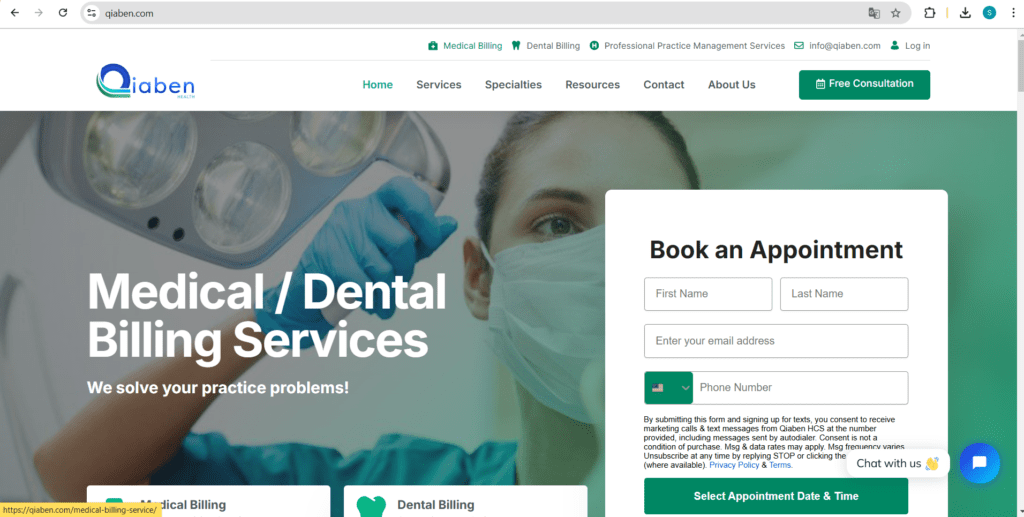
1. Qiaben Health

Dr. Jay Doshi@username I signed up with Qaiben about 4 to 5 months ago. They have been great to work with! Siva And his team are very good about communication via text or email. They get all work done and claims paid in a very efficient manner. With denials, they are very good about gathering information and resubmitting it. If we have any questions or concerns, they are very prompt to respond via a call or zoom. This has been a much better option than having someone physically in the office. I highly recommend them. dental billing companies

Qiaben Healthhas been an exceptional dental billing and insurance claims processing company. Through its sophisticated automation and highly qualified team, Qiaben allows practices to recover as much as 25% extra revenue within 6 months.

Why Choose Qiaben Health?

• AI-powered claim tracking and real-time reporting software.
• HIPAA-compliant operations to secure data protection.
• Custom pricing plans with no hidden fees.
• 98% claim approval rate, outpacing national averages.
• 24/7 Support through email, text, call, or Zoom.

Click here

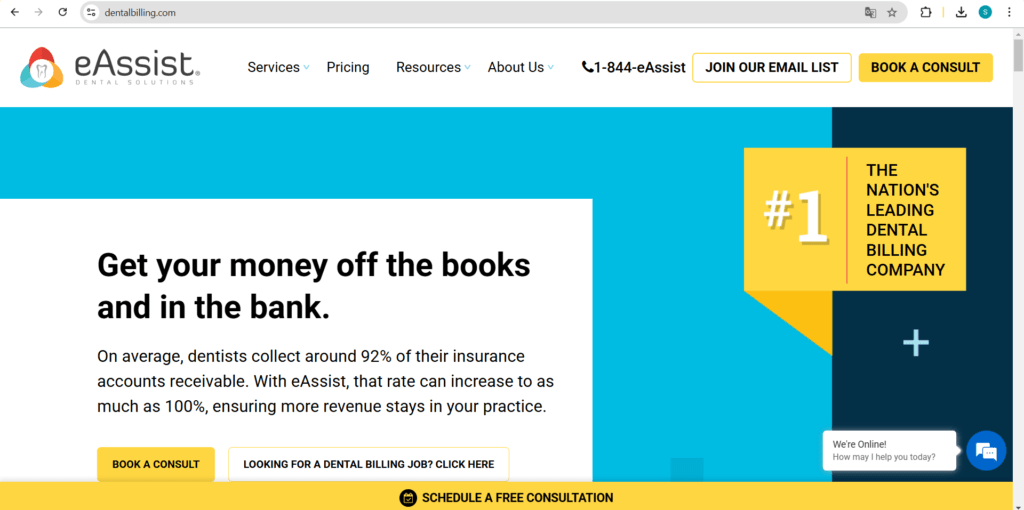
2. EAssist Dental Solutions

DR. BENJAMIN KUR@username I can't tell you how utterly relieved I was to now have the billing portion of my practice completely outside of my office, and in the hands of professionals. dental billing company

eAssist is one of the most widely used dental billing companies in the United States, offering complete insurance claims processing. Their platform is designed to take billing out of your hands completely and really boost cash flow.

Highlights:

• Thousands of clients nationwide.
• Great customer care.
• Claims follow-up and AR daily.

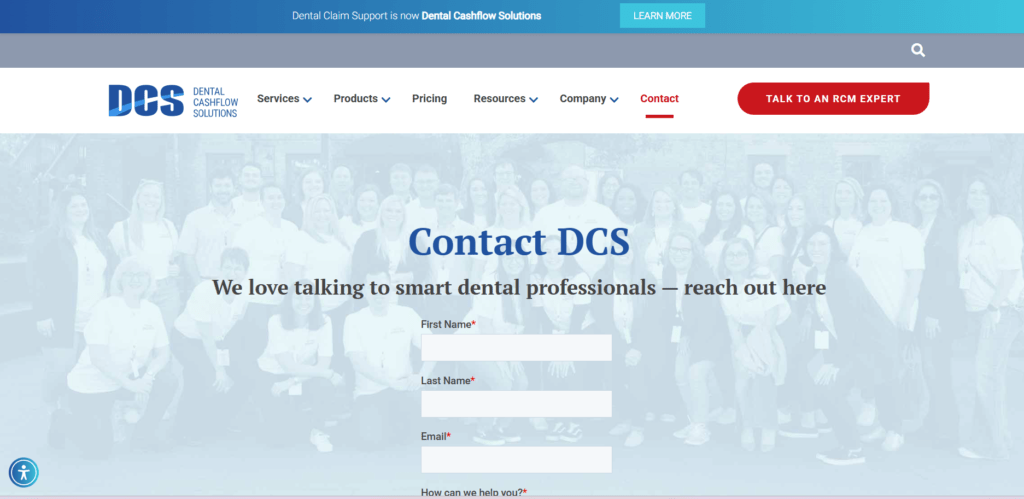
3. Dental Cash flow Solutions

Carla Ferrada@username lt is very much an example of what 'Excellent Customer Service' is all about. Their goal is to ensure all their clients' needs are addressed in a timely and professional manner at all times. dental billing company

DCS allows dental practices to cut payment delays and coding errors. Its customized dental billing and insurance claims processing service means that practices can experience financial transparency.

Highlight Features:

• Claim accuracy and compliance emphasis.
• Comprehensive reporting dashboard.
• Direct assistance from the billing support team.

4. Capline Dental Services

Pike Smiles @username "We recently had the pleasure to work with Capline Dental Services for our insurance credentialing needs and I am thoroughly impressed with their service. The credentialing process can often be complex and time-consuming, but Capline made it remarkably smooth and efficient. They were proactive in communicating every step of the process, ensuring that we were always informed and up to date. Highly recommend them!" dental billing cpmanies

Capline is proficient in diminishing AR days and speeding up the processing of insurance claims. Credentialing, verification, and resubmission are Capline's strengths.

What dentists like about Capline:

  • Predictable fees.
  • Spot-on dental credentialing.
  • Billing specialists trained through applications.

5. EZ Dental Billing

Dr. John Hill - Springwoods Smiles@username As the owner of a starting up practice, I was worried about dealing with massive amounts of information from my patients. I was lucky to find EZ Dental because they made my life much easier by taking care of everything in the most careful way possible. Thank you so much for all your good efforts!” dental billing companies

EZ Dental Billing simplifies dental billing and insurance claims processing for start-ups and growing practices. Its user-friendly service approach enables faster payment cycles and fewer errors.

Advantages:

  • Precision payment posting and coding.
  • Verifying insurance eligibility.
  • Easy onboarding of new practices.

Benefits of Outsourcing Dental Billing and Insurance Claims Processing

1. Higher Revenues

The outsourcing of procedures is estimated to provide a 20-30% increase in revenue due to higher claim acceptance and reimbursement rates.There is less administrative work, which allows practices to focus more on caring for the patients.

2. Reduced Overhead

Eliminates the in-house billing staff's salary. Eliminating the training expenses and the yearly subscription to the software, which is estimated at 30,000 dollars annually.

3. Improved Accuracy

Eliminating the 50 percent coding error reduction. Compliance with HIPAA and/or other insurance mandates.

4. Improvement of Cash Flow

Timely follow-up on AR closes the income gap leakage. Undelayedly claiming an averment ensures revenue sustainment. 

Main Features to Look for in a Dental Billing Partner

When selecting a dental billing and insurance claims processor partner, it's vital to opt for a vendor that addresses your unique practice demands and is efficient, compliant, and profitable. Here's what you need to focus on:

1. End-to-End Services

A quality dental billing company should offer comprehensive revenue cycle management, such as

  • Insurance verification to confirm patient eligibility before appointments
  • Submission of claims with correct coding to reduce denials
  • Receivables (AR) management for monitoring of unpaid claims
  • Denial management for error correction and quick resubmission of claims

This end-to-end process generates a seamless flow of work, and there is minimal revenue leakage. 

2. Proven Experience

Experience is the teacher of lessons learned in juggling the nuance of insurance claim processing and dental billing. A reputable long-term provider has dealt with multiple kinds of cases and can most efficiently handle troublesome ones. Take into consideration:

  • Case histories
  • Website reviews
  • Client referrals
  • Word of mouth from other dental practices

3. HIPAA Compliance

Client data is guarded and protected as per law. Your third-party billing vendor needs to be HIPAA compliant so that it may:
• Prevent unauthorized data breaches
• Use secure encryption and communication practices.
• Limit access to authorized users alone.
Compliance avoids trust and legal liabilities.

4. Personalized Plans

No two dental offices are the same. Whether you have a pediatric, orthodontic, or general dental practice, a good billing partner will offer personalized solutions. This ensures:

  • Improved integration with your workflow
  • Scalable services as your practice grows
  • Support for your unique specialties and volumes

5. Transparent Pricing

Steer clear of firms with obscure or confusing pricing structures. Rather, look for:

  • Transparent fee arrangements
  • No hidden fees
  • No lock-in long-term contracts unless you are sure of their service.

Companies like Qiaben offer scalable billing plans that are suitable for your practice size and billing volume. 

How to Choose the Best Dental Billing Company

Now that you have an idea of what to look for, here's a step-by-step guide to getting the best dental billing and insurance claims processing partner:

1. Verify Experience

Look for a provider with at least 5 years of dedicated experience in the dental billing industry. They must have:

  • Strong client portfolios
  • Good reviews on platforms like Google, Capterra, or G2
  • Specialty billing experience (pediatric, oral surgery, etc.)

2. Examine Technology

Manual claim tracking isn't going to cut it today. An advanced billing partner should utilize
AI-based claim tracking
• Real-time dashboards of analytics
• Predictive reporting
• Automated AR follow-up
This technology reduces errors and improves your collections.

3. Confirm Compliance

Speak with the company about their security infrastructure and handling of patient data. Confirm:
• They are HIPAA-compliant.
• They have encrypted communication.
• Data is stored securely in the cloud or secure servers.

4. Compare Pricing

Price matters — but it's not all about going for the cheapest. Rather:

  • Seek value-based pricing.
  • Request itemized breakdowns of all services included.
  • Make sure there are no secret onboarding or exit fees.

5. Request a Free Trial or Consultation

Before signing up, request a demo. Top companies like Qiaben Health provide:
• Free consultations to learn about your needs
• Brief demo of their billing process and technology
• Initially audits or analyses of your present claims to prove how they'd improve results
.

Last Thoughts

The correct partner for your dental billing and insurance claims process can boost efficiency and revenues at your practice profoundly. Of the best contenders, Qiaben Health stands out through their AI-driven system, experienced staff, and great client outcomes.
If you need to reduce claim denials, speed up payments, and boost profitability, Qiaben is the dental billing program that can transform your financial workflow. Frequently Asked Questions (FAQs) About Dental Billing and Insurance Claims Processing

FAQ

1. What is dental billing and insurance claims processing?

Dental billing and insurance claims processing refers to the submission, tracking, and resubmission of claims made to insurance companies on behalf of dental offices. It encompasses procedure coding, eligibility verification, posting payments, and resubmission of rejected or delayed claims.

2. Why should dental offices outsource billing and claims processing?

Dental claims billing and processing outsourcing improves accuracy, reduces administrative costs, and accelerates reimbursements. Outsourcing reduces the deterrent cost of in-office personnel, training, and software fees and increases collection rates by as much as 30%.

3. What are the most significant advantages of outsourced dental billing services?

• Increased revenue collection • Reduced billing errors and denials • Faster cash flow • Reduced operating costs • Enhanced HIPAA and insurance regulation compliance

4. How do I choose the best dental billing company for my practice?

Look for companies that: • Offer end-to-end solutions (claims, AR, coding). • Are best known in dental billing and insurance claims processing • Utilize advanced technology like AI for real-time tracking of claims. • Implement open pricing with no surprise fees. • Are HIPAA-compliant and safe

5. Is dental billing outsourcing safe?

Yes, reputable companies follow HIPAA guidelines to protect patients' data. They use encrypted messaging, secure websites, and robust access controls to ensure data confidentiality and prevent breaches.

6. How long does it take to see results from an outsourced billing firm?

Most practices see increased revenue and decreased AR in the first 60 to 90 days. Firms such as Qiaben Health see up to a 25% boost in revenue in six months.

7. Can outsourced billing work for start-up or small dental practices?

Yes. Solo practitioners or growing group practices outsource dental insurance claims preparation and billing to match their size of need and can liberate small groups from time-consuming chores.

8. What are dental billing outsourcing services?

• Patient eligibility verification • Claims tracking and submission • Coding and compliance checks • Payment posting • Accounts receivable (AR) management • Reporting and analytics

9. How is Qiaben Health different from other dental billing companies?

Qiaben Health combines talented billing experts and artificial intelligence technology with effective dental billing and insurance claims filing. It provides: • 98% claim acceptance • Live reporting • Effective, flexible pricing • Immediate customer support

10. How do I get started working with Qiaben or another business?

You can schedule a free consultation or demo, review their services and pricing, and onboard your practice in days. The migration is usually done seamlessly by most of the providers with minimal impact on your workflow.

How to Handle a Dental Patient for Billing Issue

· 3 min read
Qiaben Health

Maintaining clear and accurate billing is essential for building trust with your patients. Many patients struggle to understand their dental bills, and this can create stress or confusion. Here’s a simple, patient-friendly way to handle billing concerns while strengthening your practice–patient relationship.

How To Handle A Dental Patient Who Has A Problem With Their Bill?

1. Stay calm and listen actively

When a patient raises a billing concern, stay calm and listen carefully. Let them share their full concern without interruption. This shows respect and helps the patient feel heard. Once they finish, respond with empathy and a willingness to help.

2. Review the bill together

Next, sit with the patient and go through the bill line by line. Many misunderstandings come from unfamiliar codes, insurance adjustments, or service descriptions. Explain each charge in simple terms so the patient clearly understands what they’re paying for.

Click here

3. Verify the insurance details

Often, billing confusion starts with insurance coverage. Double-check the patient’s benefits, deductibles, copays, and any denied claims. If something still doesn’t look right, contact the insurance company for clarification. This step helps prevent unnecessary frustration.

4. Fix mistakes immediately

If you find an error, correct it right away. Patients appreciate honesty and transparency. Quick action builds confidence and shows that your office is committed to accuracy.

5. Offer flexible payment options

Some patients may find the bill difficult to manage. In that case, offer solutions such as payment plans, early-payment discounts, or financing options. Flexibility reduces stress and allows patients to continue their treatment without financial pressure.

6. Provide written explanations

If the patient still feels unsure, give them a written breakdown of the charges. A clear, easy-to-read explanation helps them review the information later and improves their understanding of the costs.

7. Train your team to communicate clearly

Make sure all front-office staff know how to handle billing questions confidently and professionally. With the right training, they can resolve concerns quickly and create a positive experience for every patient.

8. Follow up after resolving the issue

Finally, check back with the patient after the issue is resolved. A short phone call or email shows that your practice values their satisfaction and is committed to long-term relationships.

Conclusion

Handling billing issues becomes easier when you combine empathy, clear communication, and accuracy. By being proactive and patient-focused, your dental practice can prevent conflicts, reduce confusion, and keep patients happy—even when financial questions arise.