
Recredentialing Explained: Why Missing Deadlines Can Hurt Your Practice
09/05/2026 6 min read
Getting a physician credentialed with an insurance company is an important step, but the process doesn't end once the initial approval is completed.
Provider information needs to be reviewed and updated over time. Licenses expire, practice locations change, professional information gets updated, and insurance networks may require providers to complete the credentialing process again. This process is known as recredentialing.
What Is Recredentialing?
Recredentialing is the process of reviewing a healthcare provider's qualifications and information again after the initial credentialing process. Insurance companies and healthcare organizations may periodically ask providers to confirm that their information is still accurate and that they continue to meet applicable requirements.
The exact process and timing can vary depending on the payer, provider type, specialty, and network agreement. During recredentialing, a payer may ask for updated information such as:
- Professional license details
- Certifications
- Work history
- Malpractice insurance
- Practice locations
- Provider contact information
- NPI and other identification details
- Other required documentation
The goal is to make sure the provider's information remains current.
Why Does Recredentialing Matter?
The reason is simple: provider information can change.
A physician may move to a new office, renew a license, obtain a new certification, change specialties, or update other professional information. Payers need current information to maintain accurate provider records. Recredentialing gives both the provider and payer an opportunity to confirm that information. For a practice, staying ahead of this process can help prevent administrative problems from affecting the billing cycle.
What Happens If You Miss a Recredentialing Deadline?
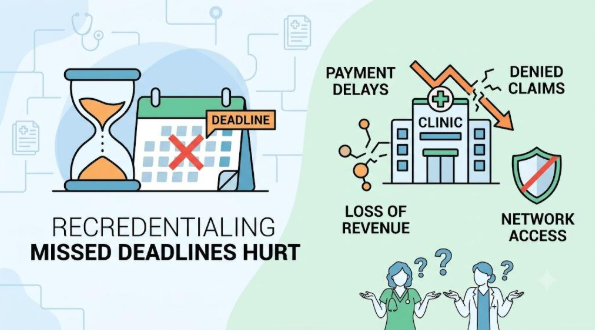
Missing a deadline doesn't always create the same outcome for every payer or provider. However, it can lead to administrative complications that may affect the provider's participation or claims.
For example, a payer may require additional documentation, place an enrollment status on hold, or require the practice to complete another process before the provider's status is restored. This can create extra work for credentialing and billing teams.
The bigger problem is that the practice may not realize there is an issue until a claim encounters a problem.
Recredentialing Is Not the Same as Initial Credentialing
The two processes are related, but they aren't exactly the same.
Initial credentialing generally happens when a provider first applies to participate with a payer or organization.
Recredentialing happens later, when the provider's credentials and information need to be reviewed again.
Both require accurate information and proper documentation, but recredentialing is often easier to overlook because the provider is already established with the practice and payer. That's exactly why deadline tracking is so important.
Why Practices Miss Recredentialing Deadlines
Medical practices manage a lot of information every day. Between patient appointments, billing, staffing, compliance, and administrative responsibilities, credentialing deadlines can easily get buried.
Some common reasons include:
- No centralized deadline tracking
- Outdated provider information
- Missing documents
- Staff changes
- Payer notices going unnoticed
- Lack of communication between departments
- Multiple providers with different renewal dates
The more providers and payers a practice works with, the harder it can become to manage everything manually.
Recredentialing Should Start Before the Deadline
Waiting until the last minute is one of the easiest ways to create unnecessary stress. Recredentialing may require gathering documents, confirming information, communicating with payers, and responding to requests. If something is missing, the practice may need additional time to resolve it.
Starting early gives the team room to deal with unexpected issues. A good process should answer three basic questions:
- What needs to be renewed?
- When is it due?
- Who is responsible for completing it?
Having clear answers to these questions can make recredentialing much easier to manage.
The Connection Between Recredentialing and Revenue
Revenue cycle problems don't always begin with a billing mistake. Sometimes, the problem starts much earlier.
A provider's credentialing status can affect whether claims are processed as expected. If a recredentialing issue isn't identified early, billing staff may discover it only after claims have already been submitted. That can turn a simple administrative deadline into a revenue-cycle problem.
This is why practices should treat recredentialing as part of their overall financial operations rather than viewing it as paperwork that belongs to a separate department.
Can Physician Credentialing Services Help?
For smaller practices, managing credentialing internally may be possible. However, larger practices or organizations working with multiple providers and payers may need additional administrative support.
This can reduce the amount of administrative work handled by internal staff and make it easier to stay ahead of important deadlines. For practices looking for additional support, Empower Growth With Trusted Physician Credentialing Services can be a natural resource to explore when managing provider credentialing and related administrative responsibilities.
A Simple Recredentialing Workflow
A practice doesn't need a complicated process to stay organized. A basic workflow can make a significant difference.
Track → Prepare → Submit → Follow Up → Confirm
First, track upcoming recredentialing deadlines. Then prepare the required documents and verify that provider information is accurate. Submit the necessary information to the payer and follow up when needed. Finally, confirm that the provider's status has been successfully updated.
The important part is not waiting until the deadline is almost here.
Recredentialing Is Part of Ongoing Practice Management
Credentialing shouldn't be treated as something that happens only when a new physician joins a practice.
Provider enrollment and credential maintenance are ongoing responsibilities. As providers, payers, and practice information change, the organization needs a process for keeping everything current. When recredentialing becomes part of routine practice management, it is less likely to become an unexpected problem.
Conclusion
Recredentialing may seem like a routine administrative task, but missing important deadlines can have consequences for a medical practice. Problems with provider status or outdated information can create additional work for billing teams and may contribute to claim delays or reimbursement issues.
For practices with multiple providers or complex payer relationships, physician credentialing services can also provide additional support and help keep the process organized.
At Qiaben, we're committed to helping healthcare providers simplify medical billing and revenue cycle management. Explore more expert insights on our blog, and if you have questions or need support with your billing processes, get in touch with our team.