
In-House vs Outsourced Dental Billing: Which Option Is Better for Your Practice?
08/27/2026 8 min read
Running a dental practice involves much more than treating patients. Along with providing quality care, dentists and their teams need to manage appointments, patient records, insurance claims, payments, and many other administrative tasks.
Dental billing is an important part of this process. A practice can choose to handle billing internally with its own staff or work with an outside billing company. Both options have advantages and challenges, so choosing the right one depends on the size of the practice, available staff, budget, and daily workload.
In this guide, we will compare in-house and outsourced dental billing in simple terms and explain what practices should consider before making a decision.
What Is In-House Dental Billing?
In-house billing means that a dental practice manages its billing activities using its own employees. The staff may be responsible for entering patient information, submitting claims, checking claim status, posting payments, following up on unpaid claims, and handling billing questions.
The practice has direct control over the entire billing process. However, it also has to manage the people, software, training, and other resources required to keep the process running smoothly.
Benefits of In-House Billing
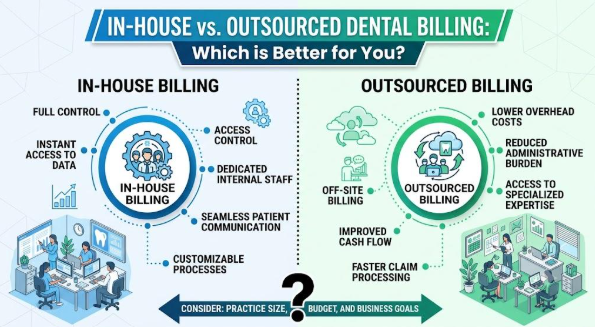
One of the biggest advantages of keeping billing in-house is direct control. The dental office can communicate with its billing staff quickly and make changes to its process whenever needed.
Other benefits include:
- Direct communication between the front desk and billing team
- Easy access to patient and billing information
- Greater control over daily billing activities
- Staff members who are familiar with the practice
- Ability to create billing procedures based on the practice's needs
For smaller practices with a manageable number of claims, an in-house team may work well if the right staff and systems are available.
What Is Outsourced Dental Billing?
Outsourced billing means that a dental practice works with an external billing company to manage some or most of its billing responsibilities.
The outside team may handle tasks such as claim submission, payment posting, insurance follow-ups, denial management, account checks, and billing reports. This allows the dental staff to spend more time on patients and other important office responsibilities.
Outsourcing does not mean the dentist loses control of the financial side of the practice. A good billing partner works with the practice and provides updates, reports, and information about the billing process.
In-House vs. Outsourced Dental Billing
The main difference is who manages the billing work.
With an in-house system, the dental practice hires and manages its own billing employees. With an outsourced model, an external team takes care of the work according to an agreed process.
Here are some important areas to compare.
1. Cost
In-house billing can involve more expenses than just employee salaries. A practice may also need to pay for training, software, benefits, equipment, and employee replacement when someone leaves.
Outsourcing can reduce some of these expenses because the billing company usually provides its own staff, systems, and expertise.
However, the actual cost will depend on the services provided and the size of the practice. It is important to compare the total cost rather than looking only at the monthly billing fee.
2. Staff and Training
In-house teams need regular training because insurance rules, billing procedures, and payer requirements can change.
Staff members may also need time to learn new software and understand different types of dental claims.
With an outsourced team, the billing company is generally responsible for training its staff and keeping them familiar with billing processes. This can reduce the training burden on the dental practice.
3. Claim Follow-Up
Submitting a claim is only one part of the billing process. Claims may be delayed, rejected, or denied and require follow-up.
When billing is handled internally, office employees need to dedicate time to checking claim status and contacting insurance companies.
An experienced outsourced team can handle these follow-ups as part of its regular workflow. This can help prevent unpaid claims from being forgotten.
4. Billing Knowledge
Dental billing requires attention to detail. Small mistakes in patient information, insurance details, procedure codes, or documentation can create problems during claim processing.
An in-house team can develop strong knowledge of the practice over time. However, keeping that knowledge updated requires ongoing training.
An outsourcing company that specializes in dental billing may have experience working with different payers, claim situations, and billing challenges.
For example, understanding dental procedure codes is important when preparing accurate claims. Practices can also learn more about specific codes through resources such as this complete guide to the D0210 dental code and FMX billing tips.
5. Time Management
Dental office employees already have many responsibilities. Front-desk staff may need to answer calls, schedule appointments, verify insurance, check patients in and out, and collect payments.
Adding a large amount of billing work can increase their workload.
Outsourcing can take some of these responsibilities away from the office team. This allows employees to focus on patient service and daily practice operations.
6. Scalability
A growing dental practice may see more patients and submit more claims. As the workload increases, an in-house team may need additional employees.
Hiring and training new staff can take time.
An outsourced billing partner may be able to adjust its support as the practice grows. This can make it easier to handle changes in billing volume without immediately expanding the internal team.
When Does In-House Billing Make Sense?
In-house billing may be a good choice for practices that:
- Have experienced billing employees
- Handle a manageable number of claims
- Want complete control over billing operations
- Have enough time and resources for staff training
- Already have reliable billing software and systems
- Can manage claim follow-ups without affecting other office tasks
If the internal team is organized and billing performance is strong, there may be no immediate reason to change the existing system.
When Should a Practice Consider Outsourcing?
Outsourcing may be worth considering when billing becomes difficult to manage internally.
For example, a practice may benefit from outside support if:
- Claims are frequently delayed or denied
- Staff members have too many responsibilities
- Insurance follow-ups are not completed on time
- Payments are taking longer to arrive
- Billing errors happen frequently
- The practice is growing quickly
- Hiring additional billing employees is expensive
- The team does not have enough billing expertise
- The dentist and office manager spend too much time dealing with billing problems
The goal should not simply be to reduce workload. The right billing process should also help the practice maintain accurate records, submit clean claims, and keep track of outstanding payments.
What Should You Ask Before Choosing a Billing Option?
Before deciding between in-house and outsourced billing, dental practices should review their current situation.
Ask questions such as:
How much time does our staff spend on billing? If employees spend several hours each week dealing with claims and insurance issues, calculate how that time affects other office activities.
How often are claims denied or rejected? A high number of rejected or denied claims may indicate that the current process needs improvement.
Are payments being collected on time? Review outstanding accounts and insurance payments to understand whether there are delays.
Do we have enough trained staff? If only one employee understands the billing process, the practice may face problems when that person is unavailable or leaves the organization.
Is the practice growing? A billing system that works for a small practice may become difficult to manage as patient volume increases.
What is the total cost? Consider salaries, software, training, employee benefits, equipment, and the time spent managing billing. Compare this with the cost of outsourcing.
How to Make the Right Decision
There is no single answer that works for every dental practice.
An in-house team can provide control and direct communication, while outsourcing can provide additional expertise and reduce the administrative workload. The best option is the one that fits the practice's size, budget, staffing, and billing needs.
Some practices may also choose a combination of both approaches. For example, the dental office can keep patient communication and payment collection in-house while outsourcing claim submission, insurance follow-up, and denial management.
Before making a change, review your current billing performance. Look at claim errors, outstanding balances, collection time, staff workload, and overall costs. These numbers can help you make a decision based on facts rather than assumptions.
Final Thoughts
Choosing between in-house and outsourced dental billing depends on your practice's size, workload, staff, and financial goals. While an in-house team can offer direct control, managing everything internally can become challenging as the practice grows. Outsourcing can help reduce administrative work, improve consistency, and give your team more time to focus on patients.
This is where Qiaben can be helpful. Qiaben provides dental billing support that can help practices manage billing tasks, follow up on claims, reduce common billing issues, and keep the revenue cycle more organized. By having the right support in place, dental practices can spend less time dealing with billing challenges and more time focusing on patient care and practice growth.