
How Credentialing Affects Medical Billing and Reimbursement
09/01/2026 7 min read
Getting a new physician ready to see patients involves more than setting up an office and scheduling appointments. Before a provider can bill many insurance companies, there are important steps that need to be completed behind the scenes. One of the most important is provider credentialing.
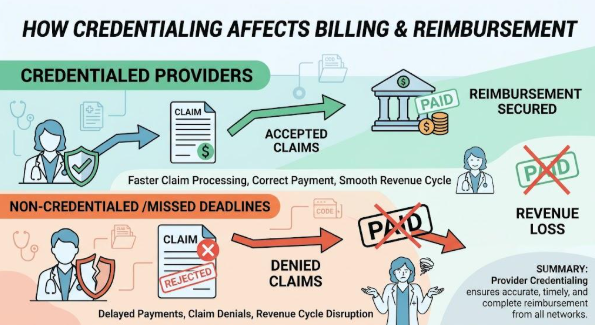
Credentialing verifies a healthcare provider's qualifications and helps insurance companies determine whether the provider can participate in their network. When credentialing is delayed, incomplete, or not properly maintained, it can create problems for the practice's billing and reimbursement process.
What Is Provider Credentialing?
Provider credentialing is the process of verifying a healthcare professional's qualifications and information. Depending on the situation, this may include reviewing education, licenses, certifications, work history, malpractice coverage, and other professional details. Insurance companies use this information when evaluating providers for participation in their networks.
After the necessary information has been reviewed and the enrollment process is completed, the provider can begin working with the payer according to the terms of the agreement. The process can take time, especially when applications contain missing information or when different payers have different requirements.
Why Does Credentialing Matter for Medical Billing?
Think about it this way: a physician can provide excellent care, but the practice still needs the correct payer relationship in place to receive reimbursement from insurance. If a provider isn't properly enrolled or credentialed with a payer, claims may face problems even when the medical service itself was appropriate.
This is why credentialing and billing need to work together. The billing team needs accurate information about the provider's payer participation, effective dates, specialties, identifiers, and other relevant details. Without that information, submitting claims correctly can become much more difficult.
What Happens When Credentialing Is Delayed?
Credentialing delays can create a frustrating situation for a medical practice. Imagine hiring a new physician and filling their schedule with patients, only to discover that the provider's payer enrollment hasn't been completed. The physician may be seeing patients, but the practice can run into problems when it tries to submit claims.
Depending on the circumstances, claims may be rejected, delayed, or require additional follow-up. This can create a gap between providing care and receiving payment. For a growing practice, that gap can put unnecessary pressure on cash flow.
Credentialing Can Affect When a Provider Starts Billing
A new provider may be ready to start seeing patients, but billing readiness is a separate issue. The practice needs to know which payers the provider can bill, when participation becomes effective, and whether the required enrollment information has been completed.
This is why credentialing should begin early rather than being treated as something to complete at the last minute. Starting the process early gives the practice more time to address missing documents, respond to payer requests, and resolve issues before they affect billing.
Incorrect Information Can Create Billing Problems
Credentialing involves a lot of information, and even a small mistake can cause delays. For example, an incorrect provider identifier, outdated address, missing document, or mismatch between enrollment information and the claim can create additional work.
That's why practices need to keep provider information accurate across their systems.
Some important information may include:
- Provider name and credentials
- National Provider Identifier (NPI)
- State license information
- Specialty
- Practice locations
- Tax identification information
- Payer enrollment details
- Effective dates
Keeping these details organized can make both credentialing and billing easier to manage.
Credentialing and Claim Denials
Claim denials can happen for many different reasons, and credentialing-related issues are one area practices need to watch. If the payer does not recognize the provider as properly enrolled, or if information on the claim doesn't match the payer's records, the claim may require additional investigation.
The problem doesn't necessarily end with one rejected claim. Billing staff may need to research the issue, contact the payer, correct information, and resubmit the claim. That takes time, and repeated issues can affect the revenue cycle.
Credentialing Doesn't End After Enrollment
One common mistake is thinking credentialing is a one-time process. Provider information can change over time. Licenses may need renewal, providers may move to another location, specialties can change, and payer information may need to be updated.
This is why credentialing maintenance is just as important as the initial application. A practice should have a process for tracking important provider information and renewal dates so that changes don't unexpectedly affect billing.
How Credentialing Connects With the Revenue Cycle
Medical billing is a process that starts long before a claim is submitted. Provider enrollment and credentialing are part of the foundation that supports the revenue cycle. When provider information is accurate and payer relationships are properly established, billing teams have a stronger starting point for submitting claims.
From there, other parts of the revenue cycle come into play, including:
Patient information → Eligibility → Documentation → Coding → Claim submission → Payer processing → Payment
A problem at an earlier stage can sometimes create problems later in the process.
Credentialing Is Even More Important for Specialty Practices
Different medical specialties can have different documentation, coding, payer, and enrollment considerations. A cardiology practice may have different billing requirements from a dermatology, orthopedic, behavioral health, or pediatric practice. This is why a one-size-fits-all approach doesn't always work well.
A billing team that understands the provider's specialty can better understand the connection between credentialing, coding, claims, and reimbursement. Qiaben, for example, provides billing and revenue-cycle support tailored to different medical specialties, including services such as coding, claim submission, denial management, and payment posting.
For practices looking for a broader view of specialty-specific billing, you can explore complete specialty-based medical billing solutions.
How Practices Can Avoid Credentialing-Related Billing Issues
The best time to think about credentialing problems is before they affect claims. Practices can make the process easier by starting applications early, keeping provider information organized, and regularly checking enrollment status.
It also helps to create a clear process for communicating changes. When a provider gets a new license, changes locations, joins another payer network, or updates professional information, the appropriate teams should know about it. Good communication between credentialing, front-office, clinical, and billing teams can prevent small information gaps from becoming larger revenue-cycle problems.
What Happens When a New Provider Joins a Practice?
When a new physician joins a practice, credentialing should be part of the onboarding plan, not something added at the end. Some practices manage the process internally, while others choose physician credentialing services to help organize applications, track payer enrollment, verify provider information, and follow up on pending requirements. The right approach depends on the size of the practice and how many providers and payers need to be managed.
The practice may need to gather professional documents, submit payer applications, monitor application progress, and confirm when participation becomes effective.
Credentialing and Reimbursement: The Bigger Picture
Healthcare reimbursement depends on many moving parts. Accurate documentation, appropriate coding, insurance eligibility, claim submission, payer requirements, and payment processing all contribute to the final outcome. Credentialing sits near the beginning of this process.
If the provider isn't properly connected to the payer, even an accurately coded claim may encounter problems. That's why practices shouldn't look at credentialing and medical billing as two completely separate activities. They are connected parts of the same revenue cycle.
Conclusion
Credentialing may happen behind the scenes, but its impact can reach far beyond paperwork. When provider enrollment is delayed or information isn't kept up to date, medical practices can face claim issues, reimbursement delays, and additional administrative work. A well-managed credentialing process gives the billing team a stronger foundation. It helps ensure that providers are properly enrolled, their information is accurate, and the practice is better prepared to submit claims and receive reimbursement.
For medical practices, the goal isn't simply to get a provider credentialed. It's to make sure credentialing, billing, and the overall revenue cycle work together.
At Qiaben, we're committed to helping healthcare providers simplify medical billing and revenue cycle management. Explore more expert insights on our blog, and if you have questions or need support with your billing processes, get in touch with our team.