
How Analytics Improve Revenue Cycle Performance and Help Practices Collect More
08/26/2026 6 min read
Running a healthcare practice involves much more than providing good patient care. Practices also need to manage claims, payments, insurance follow-ups, patient balances, denials, and many other financial tasks.
When these activities are handled without clear data, it can be difficult to know where problems are happening. A practice may notice that payments are slow or claims are being denied, but it may not know the exact reason.
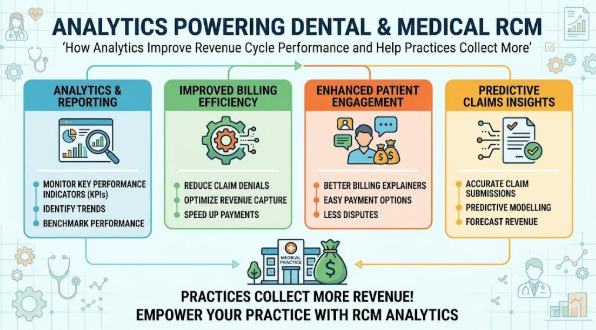
What Is Revenue Cycle Analytics?
Revenue cycle analytics means using data from different parts of the billing process to understand how well the revenue cycle is working.
This data can come from areas such as:
- Claims
- Payments
- Denials
- Accounts receivable
- Patient balances
- Insurance activity
- Charge entry
- Payment posting
- Collections
Instead of looking at each number separately, analytics helps practices understand how these activities are connected.
For example, if a practice notices that payments are taking longer than usual, analytics can help identify whether the problem is related to claim delays, payer processing, missing information, or another part of the workflow.
Why Is Analytics Important for Revenue Cycle Management?
Without reliable data, practice managers may have to rely on assumptions.
They may think claims are being submitted on time, staff are following up regularly, or payments are being collected properly. However, the actual numbers may tell a different story.
Analytics provides a clearer picture of what is happening.
It can help practices:
- Find billing problems
- Identify payment delays
- Track financial performance
- Understand denial patterns
- Monitor outstanding balances
- Compare performance over time
- Improve staff workflows
- Make better business decisions
The goal is not simply to collect more data. The goal is to use the data to take useful action.
1. Analytics Helps Find Revenue Leaks
Revenue leaks can happen in many small ways.
A claim may not be submitted on time. A payment may be posted incorrectly. An underpayment may go unnoticed. A patient balance may remain unpaid for months.
Each issue may seem small, but together they can have a significant effect on practice revenue.
Analytics can help identify these patterns.
For example, a practice can compare expected payments with actual payments. If certain claims or payers regularly pay less than expected, the practice can investigate the reason.
Finding these issues early can help prevent unnecessary revenue loss.
2. It Helps Identify Claim Problems
A successful revenue cycle starts with accurate and timely claims.
Analytics can show how many claims are being submitted, how many are rejected, and how long they take to move through the system.
Practices can review:
- Claim submission volume
- Rejected claims
- Claims waiting for action
- Average processing time
- Claims requiring correction
- Common rejection reasons
This information can help the billing team identify repeated problems and improve the process.
3. Analytics Makes Denial Management More Effective
Claim denials are a common challenge for healthcare practices.
However, simply knowing the number of denials is not enough. Practices should also understand why claims are being denied.
Analytics can group denials by reason, payer, provider, procedure, or department.
For example, if a large number of denials are caused by missing information, the practice can review its documentation process.
If one payer has a high number of denials compared with others, the billing team can investigate the payer-specific requirements.
This changes denial management from simply fixing individual claims to identifying the causes behind repeated problems.
4. It Helps Monitor Accounts Receivable
Accounts receivable (AR) represents money that is still owed to the practice.
A growing AR balance can be a warning sign, but the total amount alone does not tell the complete story.
Analytics can break AR into different age groups, such as:
- 0-30 days
- 31-60 days
- 61-90 days
- 91-120 days
- More than 120 days
This makes it easier to identify older balances that may require immediate attention.
A practice can also separate insurance balances from patient balances to understand where collection problems are occurring.
5. Analytics Helps Improve Patient Collections
Patient responsibility has become an important part of the revenue cycle.
Analytics can help practices understand how much patients owe, how quickly they pay, and where unpaid balances are increasing.
For example, a practice may discover that a large percentage of patient balances remain unpaid for more than 90 days.
This could encourage the practice to review how it communicates costs, provides payment information, or follows up on outstanding balances.
The goal should be to make the payment process clear and convenient for patients while maintaining a healthy cash flow.
6. It Helps Measure Staff Performance
Revenue cycle analytics can also provide insight into workflow performance.
For example, managers can monitor:
- How quickly charges are entered
- How quickly claims are submitted
- How many claims are worked each day
- How quickly payments are posted
- How many denied claims are resolved
- How many accounts are followed up on
These numbers can help managers identify workflow bottlenecks.
The purpose is not to simply monitor employees. Instead, the information can show where the team may need additional resources, training, or process improvements.
7. Analytics Helps Identify Payer Trends
Different insurance companies may have different payment behaviors.
One payer may process claims quickly, while another may have longer processing times. Some payers may also have higher denial or underpayment rates.
Analytics allows practices to compare payer performance.
They can look at:
- Payment turnaround time
- Denial frequency
- Reimbursement levels
- Underpayment patterns
- Appeal outcomes
- Outstanding balances
This information can help practices understand which payer relationships may need closer attention.
8. It Helps Practices Make Faster Decisions
Without analytics, practice managers may spend a lot of time collecting information from different systems and reports.
A well-organized dashboard can bring important information together in one place.
Instead of asking "Why are payments slower this month?", managers can look at the data and identify whether the problem is related to claims, denials, payer delays, patient balances, or another part of the revenue cycle.
This allows practices to respond faster.
How Qiaben Can Support Revenue Cycle Improvement
Managing all these numbers and billing activities manually can be difficult for a busy practice. This is where the right revenue cycle support can be useful.
Qiaben helps practices manage important revenue cycle activities and organize billing workflows. By supporting areas such as claims management, denial follow-up, payment tracking, and other billing processes, Qiaben can help practices get better visibility into their financial operations.
Practices that want to understand how better revenue cycle management can support financial performance can also explore this guide on boosting practice revenue with dental revenue cycle management.
The combination of accurate data, regular monitoring, and consistent follow-up can help practices identify problems earlier and work toward better revenue cycle performance.
Final Thoughts
Analytics gives practices a clearer view of their revenue cycle and helps identify delays, billing issues, and missed revenue opportunities. Qiaben helps practices manage key billing and revenue cycle activities, including claims, denials, payment follow-ups, and billing performance. With the right data and support, practices can improve their workflows, strengthen collections, and maintain a healthier revenue cycle.