
How Analytics Improve Revenue Cycle Performance
09/02/2026 8 min read
Running a medical practice is about more than providing great patient care. There is also a financial side that needs constant attention. Claims need to be submitted correctly, payments need to be collected, denials need to be followed up on, and unpaid balances need to be monitored.
The challenge is that revenue cycle problems are not always easy to see. A practice may be submitting hundreds or thousands of claims every month. Somewhere in that data, there could be repeated denials, delayed payments, coding issues, or payer-related problems that are quietly affecting revenue.
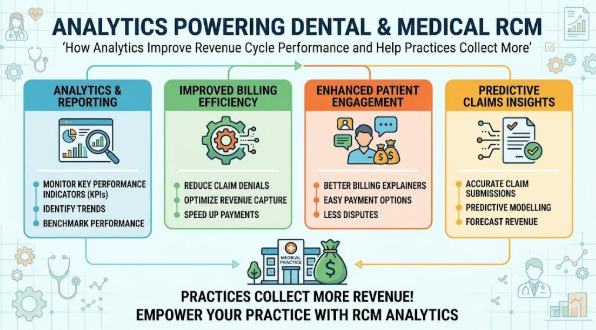
What Is Revenue Cycle Analytics?
Revenue cycle analytics means using billing and financial data to understand how well a practice's revenue cycle is performing. Instead of simply asking, "Did we get paid?", analytics helps answer more useful questions:
- Why was the claim denied?
- Which payers are taking longer to pay?
- Where are payments being lost?
- Are certain providers or procedures showing repeated billing problems?
- Is the practice collecting as much as it should?
When these patterns become visible, practices can make better decisions instead of relying only on assumptions.
Why Looking at the Numbers Matters
A medical practice generates a lot of billing data every day. Claims, payments, adjustments, denials, patient balances, and accounts receivable all create information that can tell a story about the health of the revenue cycle. The problem is that simply having the data isn't enough. Someone needs to understand what the numbers are saying.
For example, a practice may notice that its denial rate has increased. That number alone tells you there is a problem, but analytics can help the team dig deeper and determine whether the increase is connected to a specific payer, procedure, provider, coding issue, or workflow. That's when data becomes useful.
Analytics Can Help Find Revenue Leakage
Revenue leakage doesn't always happen because of one major mistake. Sometimes it comes from small problems that happen repeatedly. A missed charge here, an underpayment there, or a claim that remains unresolved for too long may not seem serious on its own. But when these issues happen across hundreds of claims, the financial impact can become much larger.
Analytics can help identify these patterns. For example, billing data may reveal:
- Repeated underpayments from a particular payer
- Procedures that are frequently denied
- Claims remaining unpaid for long periods
- Missing or inconsistent charges
- Increasing patient balances
- Coding patterns that need attention
Once the practice knows where the problem is, it has a better chance of fixing it.
Analytics Can Help Reduce Claim Denials
When a claim is denied, someone needs to determine why it happened, correct the issue when possible, and decide whether the claim should be resubmitted or appealed. Looking at each denial separately can help resolve individual claims, but analytics can reveal something more valuable: repeated patterns.
For example, if the same denial reason appears again and again, the practice may have an underlying workflow or documentation issue. Instead of repeatedly fixing the same problem, the practice can look for the reason behind the pattern.
Finding Problems Before They Become Bigger
One of the biggest advantages of analytics is that it can help practices move from reacting to problems to identifying them earlier. Imagine that a payer normally processes claims within a certain period, but payments are suddenly taking much longer. If the practice notices this early, the billing team can investigate the change.
The same applies to denials, accounts receivable, and reimbursement. The goal isn't just to understand what went wrong. It's to identify problems before they become expensive.
Analytics Can Show Payer Performance
Not every payer behaves the same way. Some may process claims quickly, while others may have longer payment cycles. Some may show higher denial rates or recurring issues with particular procedures. Analytics can help practices compare payer performance and identify unusual trends.
Useful areas to monitor can include:
- Average reimbursement time
- Denial rates
- Underpayment patterns
- Outstanding accounts receivable
- Payment trends
- Claim acceptance rates
This information can help practices understand where their revenue cycle is performing well and where it needs attention.
Understanding Accounts Receivable
Accounts receivable, or A/R, represents money that is still owed to the practice. A growing A/R balance isn't always a problem by itself. The important question is how old those balances are and why they remain unpaid. Analytics can break down A/R by factors such as payer, age, provider, or claim status.
For example, if a large portion of outstanding balances is more than 90 days old, the practice may need to investigate why those claims haven't been resolved. Instead of looking at one large A/R number, analytics helps turn that number into information that the billing team can act on.
Analytics Can Improve Decision-Making
Without reliable data, practice decisions can sometimes become based on assumptions. A manager might believe that one payer is causing most billing problems, while the actual issue may come from a particular procedure or documentation workflow. Analytics provides a clearer picture.
When practice leaders can see trends across claims, payments, denials, and A/R, they can make decisions based on what is actually happening. This can help with staffing, workflow improvements, payer follow-up, and other revenue cycle decisions.
Manual Reviews Can Miss Patterns
Manual billing reviews still have an important role, but reviewing a small sample of claims may not reveal every problem. Imagine a practice processes thousands of claims every month. A staff member may review a limited number of them and find a few errors. But what about problems that occur across hundreds of other claims?
Analytics can review larger amounts of billing information and identify patterns that may be difficult to notice manually. This is especially useful when the same issue appears repeatedly but doesn't stand out on an individual claim.
Analytics Should Lead to Action
Analytics is not useful simply because it produces charts and reports. The real value comes from what a practice does with the information.
If analytics shows that a particular denial happens frequently, the team should investigate the cause. If one payer consistently underpays certain claims, the practice may need to review those payments more closely. If A/R is increasing, the team needs to understand what is causing the delay.
How Intelligent Analytics Can Find Hidden Problems
Some revenue problems are difficult to identify by looking at individual claims. They become clearer when billing information is analyzed as a larger pattern. For example, a practice might discover that certain procedures have unusually high denial rates, some claims are consistently underpaid, or particular accounts are repeatedly aging beyond expected payment periods.
Intelligent billing analytics can help identify these types of patterns and reveal where revenue may be leaking from the billing process. You can learn more about this approach in Qiaben's article, How Intelligent Billing Analytics Identify Patterns That Leak Revenue.
Analytics Can Support a Healthier Revenue Cycle
A strong revenue cycle isn't simply about collecting more money. It's also about creating a process that is consistent, predictable, and easier to manage. When practices understand where claims are getting stuck and why payments are delayed, they can make improvements at the source. Over time, this can help reduce repeated problems and make the billing process more efficient.
The goal is not to chase every problem after it happens. It's to understand the patterns well enough to prevent the same problems from happening again.
What Should Practices Look for in Analytics?
Not every analytics solution will provide the same value. Practices should look for tools that make complex billing information easy to understand and connect the data to real revenue cycle problems.
Useful capabilities may include:
- Clear dashboards and reports
- Denial trend analysis
- A/R monitoring
- Payer performance tracking
- Payment and reimbursement analysis
- Revenue leakage identification
- Provider or procedure-level reporting
Most importantly, the information should be easy for the billing team and practice leadership to understand and use.
Conclusion
A medical practice can have a large amount of billing data and still struggle to understand where revenue is being lost. Revenue cycle analytics helps change that by turning billing information into useful insights. It can help practices identify denial patterns, monitor A/R, understand payer performance, find potential underpayments, and recognize problems that may otherwise remain hidden.
The real benefit isn't simply having more reports. It's having better visibility into what's happening across the revenue cycle and using that information to make smarter decisions.
At Qiaben, we're committed to helping healthcare providers simplify medical billing and revenue cycle management. Explore more expert insights on our blog, and if you have questions or need support with your billing processes, get in touch with our team.