
ePCR to Payment: What Happens to an Ambulance Claim After the Ride?
09/12/2026 6 min read
An ambulance ride may end when the patient reaches the destination, but the billing process is just beginning.
After the transport, the electronic Patient Care Report (ePCR) becomes an important source of information for creating and submitting the ambulance claim. The information documented by the EMS crew must be accurate, complete, and consistent with the services being billed.
So, what happens between completing the ePCR and receiving payment?
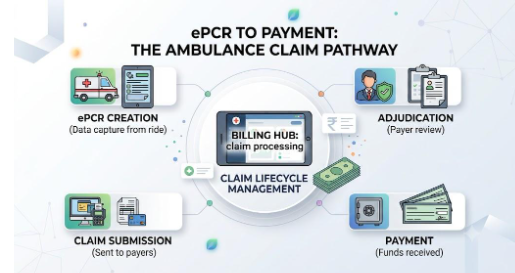
1. The ePCR Is Reviewed
The first step is reviewing the ePCR for completeness and accuracy.
The report may contain important details such as the patient's condition, assessment findings, treatment provided, transport information, crew details, destination, and mileage. These details help the billing team determine what can be appropriately reported on the claim.
If important information is missing or inconsistent, the claim may need to be reviewed before submission.
2. The Transport Level Is Determined
The billing team reviews the documentation to determine the appropriate level of service.
For example, the documentation needs to support whether the transport qualifies for BLS, ALS, or another applicable ambulance service level. The billed service should match what was actually provided and documented.
This is particularly important because ambulance claims contain specialized coding and documentation requirements.
3. Codes and Modifiers Are Assigned
After reviewing the ePCR, the billing team assigns the appropriate billing codes.
Ambulance claims may require HCPCS codes, diagnosis codes, mileage, and origin and destination modifiers. Each part of the claim needs to correspond with the transport documentation.
A coding or modifier error can lead to a rejected or denied claim, even when the ambulance service itself was appropriate.
4. Medical Necessity Is Reviewed
For applicable Medicare claims, medical necessity is an important part of the billing process.
The documentation should explain the patient's condition and why ambulance transportation was necessary. CMS notes that having a physician certification statement alone does not establish medical necessity; the applicable program requirements and supporting documentation must also be met.
For a deeper explanation of Medicare requirements, see Medicare Ambulance Billing Guidelines Every EMS Agency Must Follow.
5. The Claim Is Checked Before Submission
Before sending the claim to the payer, the billing team performs a final review.
This may include checking patient information, insurance details, transport dates, codes, modifiers, mileage, medical necessity documentation, and other claim information.
The purpose is simple: identify problems before the payer receives the claim.
6. The Claim Is Submitted
Once the claim passes the required checks, it is submitted to the appropriate payer.
Depending on the patient's coverage, the payer may be Medicare, Medicaid, a commercial insurance company, or another responsible payer.
Medicare ambulance services are subject to the Medicare Part B Ambulance Fee Schedule, which CMS maintains with payment information and geographic designations.
7. The Payer Processes the Claim
The payer reviews the claim and determines whether it meets its applicable requirements.
The claim may be accepted and processed for payment, rejected because information needs to be corrected, or denied because a coverage or documentation requirement was not satisfied.
This is why claim tracking is an important part of the ambulance billing workflow.
8. Denied or Rejected Claims Are Investigated
A rejected claim and a denied claim are not necessarily the same thing.
A rejected claim may require correction before it can be processed, while a denied claim may require investigation, additional documentation, correction, or an appeal depending on the reason.
The billing team reviews the payer's response, identifies the underlying issue, and takes the appropriate next step.
9. Payment Is Posted
When the payer sends payment, the payment is posted to the appropriate patient account.
The billing team compares the payment with the payer's remittance information to determine what was paid, what was adjusted, and whether any balance remains.
Accurate payment posting helps keep the agency's financial records organized and makes it easier to identify underpayments or remaining balances.
10. Outstanding Balances Are Followed Up
The process does not always end with the first payment.
If an amount remains unpaid, the billing team may need to follow up with the payer or determine whether another responsible payer or patient balance applies.
Consistent follow-up helps prevent unpaid claims from becoming old accounts receivable.
Why the ePCR Matters So Much
The ePCR is more than a clinical record. Its information can have a direct effect on the billing process.
When the ePCR is incomplete or does not support the services reported on the claim, the billing team may have difficulty establishing that the billed service matches the transport.
That is why EMS agencies should encourage accurate documentation from the beginning. A strong process connects patient care documentation → coding → claim submission → payment.
Where Ambulance Billing Can Go Wrong
Problems can occur at almost any stage. Missing documentation, incorrect coding, wrong modifiers, inaccurate mileage, eligibility issues, or unsupported medical necessity can all create billing challenges.
The solution is not simply to submit claims faster. EMS agencies need a workflow where the ePCR is carefully reviewed before the claim is submitted.
For agencies that need specialized support, ambulance billing services can help manage the process from claim preparation and coding through submission, denial follow-up, and payment posting.
From Ride to Revenue
The journey from an ambulance ride to payment involves much more than sending a bill.
The ePCR provides the foundation. The billing team reviews the documentation, assigns appropriate codes, verifies claim details, submits the claim, tracks its progress, handles issues, and posts the final payment.
When every stage is connected, EMS agencies can create a more consistent billing workflow while reducing avoidable errors and administrative delays.
Conclusion
An ambulance claim does not end when the patient reaches the destination. The journey from ePCR to payment involves accurate documentation, coding, claim submission, follow-up, and payment posting. When each step is handled carefully, EMS agencies can reduce avoidable billing issues and keep their revenue cycle moving efficiently. A structured process, supported by reliable ambulance billing services when needed, can help turn accurate patient care documentation into timely and accurate reimbursement.
At Qiaben, we're committed to helping healthcare providers simplify medical billing and revenue cycle management. Explore more expert insights on our blog, and if you have questions or need support with your billing processes, get in touch with our team.