
Credentialing vs Privileging: What Physicians Need to Know
09/06/2026 6 min read
Physicians often hear the terms credentialing and privileging during the process of joining a hospital, healthcare organization, or insurance network. Because both involve reviewing a physician's qualifications, it is easy to think they mean the same thing. They do not.
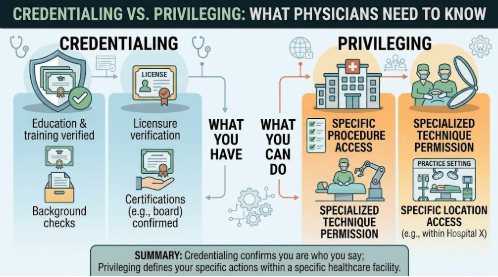
Credentialing and privileging are related processes, but they serve different purposes. Credentialing focuses on verifying a physician's qualifications and professional background, while privileging focuses on deciding which specific medical services or procedures the physician is authorized to perform within an organization.
What Is Physician Credentialing?
Credentialing is the process of verifying a physician's professional qualifications and background. Organizations may review information such as:
- Medical education and training
- State medical licenses
- Board certifications
- Work history
- Professional references
- Malpractice insurance
- Certifications
- Professional affiliations
- NPI and other provider information
Insurance companies, hospitals, medical groups, and other healthcare organizations may use credentialing to determine whether a physician meets their requirements.
What Is Privileging?
Privileging is different.
While credentialing asks, "Is this physician qualified?", privileging asks, "What procedures and services is this physician qualified and authorized to perform here?"
A hospital or healthcare organization may grant privileges based on a physician's education, training, experience, competency, and other requirements.
For example, a surgeon may be credentialed by a hospital, but the hospital may separately determine which surgical procedures the physician is allowed to perform. Privileges can be specific to a facility. A physician may have permission to perform a particular procedure at one hospital but may need to go through a separate privileging process at another organization.
Credentialing vs. Privileging: The Main Difference
The simplest way to understand the difference is:
Credentialing = Verifying qualifications
Privileging = Authorizing specific clinical activities
Credentialing establishes that a physician has the appropriate professional background and qualifications.
Privileging determines the scope of clinical services the physician can provide within a particular organization.
Although they are separate processes, they often work together. An organization may use information collected during credentialing when making decisions about clinical privileges.
Why Does Credentialing Matter?
Credentialing is important for more than administrative compliance. For medical practices, proper credentialing can affect whether physicians are able to participate in insurance networks and whether the practice can properly bill participating payers. A delay in credentialing can create problems when a new physician is ready to see patients but their payer enrollment or participation is not yet active.
This connection between credentialing and revenue cycle management is important. For a deeper look at this relationship, see How Credentialing Affects Medical Billing and Reimbursement.
When credentialing information is incomplete, outdated, or inconsistent with payer records, practices may also have to spend additional time correcting information and following up on claims.
Why Does Privileging Matter?
Privileging helps healthcare organizations make sure physicians perform services that match their verified qualifications and competencies.
This can support:
- Patient safety
- Quality of care
- Appropriate use of clinical resources
- Compliance with organizational requirements
- Clear definition of a physician's scope of practice
Privileging therefore gives healthcare organizations a structured way to determine what clinical activities a physician can perform.
Is Credentialing Required Before Privileging?
In many healthcare organizations, credentialing information plays an important role in the privileging decision. Before granting privileges, an organization may need to review a physician's qualifications, training, experience, licenses, certifications, and other relevant information.
The exact process can vary by organization, specialty, state, and facility. This is why physicians should not assume that completing one process automatically completes the other. A physician may be credentialed but still need specific privileges before performing certain procedures at a particular facility.
Credentialing and Insurance Enrollment Are Also Different
Another common source of confusion is the difference between credentialing and insurance enrollment. Credentialing generally involves verifying the physician's professional qualifications.
Provider enrollment involves establishing the physician's participation with a specific insurance payer and making sure the necessary information is properly submitted and maintained. For a medical practice, keeping all three areas organized, credentialing, privileging, and payer enrollment, can make provider onboarding much smoother.
Common Mistakes Physicians and Practices Should Avoid
Several common mistakes can slow down the process.
1. Submitting incomplete information
Missing documents or incomplete applications can lead to additional requests and delays.
2. Providing outdated information
Licenses, certifications, addresses, malpractice coverage, and other professional information may change over time. Outdated information can create verification problems.
3. Assuming credentialing equals privileging
A physician may have verified qualifications but still need approval for specific procedures or services.
4. Waiting until the last minute
Credentialing, enrollment, and privileging can involve multiple steps. Starting early gives the practice more time to resolve issues.
5. Not tracking renewal dates
Credentialing and privileges may require periodic review or renewal. Missing an important deadline can create unnecessary administrative problems.
How Can Practices Stay Organized?
A simple tracking system can make these processes easier to manage.
Practices should maintain an up-to-date record of each provider's:
- Credentials
- Licenses
- Certifications
- Payer enrollments
- Privileges
- Expiration dates
- Application status
- Renewal requirements
It is also helpful to assign clear responsibility for monitoring deadlines and following up on pending applications.
Larger practices may choose physician credentialing services to help manage applications, documentation, payer follow-ups, status tracking, and renewal requirements. This can reduce the administrative workload for internal staff and provide a more structured credentialing process.
Credentialing and Privileging Should Work Together
Although credentialing and privileging have different purposes, they are both important parts of provider management. Credentialing helps an organization understand and verify a physician's qualifications.
Privileging helps determine which clinical services that physician can perform within the organization.
When these processes are properly coordinated, practices and healthcare organizations can reduce administrative confusion and make provider onboarding more efficient.
Final Thoughts
Credentialing and privileging are not the same thing, but both play an important role in healthcare operations. Credentialing verifies a physician's qualifications, while privileging determines the clinical services and procedures the physician is authorized to perform within a specific organization. Understanding this difference can help physicians and practice managers plan the onboarding process more effectively, maintain accurate provider information, and avoid unnecessary delays.
At Qiaben, we're committed to helping healthcare providers simplify medical billing and revenue cycle management. Explore more expert insights on our blog, and if you have questions or need support with your billing processes, get in touch with our team.