
5 Dental Billing Numbers Every Practice Owner Should Check Every Month
09/04/2026 6 min read
Running a dental practice is not only about providing excellent patient care. Practice owners also need to understand how well the business is performing financially. One of the easiest ways to do this is by checking a few important dental billing numbers every month. You do not need to be a financial expert to understand these numbers. A simple monthly review can show where money is coming from, where payments are getting delayed, and where your billing process may need improvement.
Here are five important dental billing numbers every practice owner should check each month.
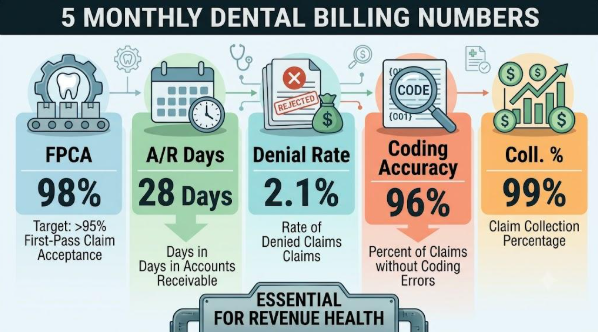
1. Total Accounts Receivable
Accounts receivable, often called A/R, is the amount of money that is still owed to your dental practice. This money may be owed by insurance companies, patients, or both. A high A/R balance does not always mean something is wrong, but a growing balance can be a warning sign.
For example, if your practice normally has $50,000 in outstanding payments but that number increases to $80,000 over several months, you should investigate why.
Look at your A/R by age:
- 0-30 days
- 31-60 days
- 61-90 days
- 90+ days
Older A/R deserves special attention because the longer a balance remains unpaid, the harder it can become to collect.
Reviewing A/R every month helps you identify unpaid claims and patient balances before they become long-term problems.
2. Claim Denial Rate
Your claim denial rate tells you how many submitted claims are being denied by insurance companies. A high denial rate can indicate problems with your billing process. Common reasons include incorrect patient information, coding mistakes, missing documentation, eligibility problems, and authorization issues.
For example, if you submit 500 claims in a month and 25 are denied, your denial rate is 5%. The number itself is important, but you should also look at why claims are being denied. If the same denial reason appears again and again, there may be a process problem that needs to be fixed.
3. First-Pass Claim Acceptance Rate
First-pass claim acceptance measures how many claims are accepted the first time they are submitted without needing corrections or resubmission. This is an important number because clean claims usually move through the payment process more smoothly.
A low first-pass acceptance rate may indicate that your team needs to improve areas such as:
- Patient information verification
- Insurance eligibility checks
- Dental coding
- Documentation
- Claim information
- Authorization requirements
The goal is to submit accurate claims that can move through the payer process without unnecessary delays. By checking this number every month, practice owners can quickly see whether billing accuracy is improving or declining.
4. Patient Collection Rate
Insurance payments are only one part of a dental practice's revenue. Patients are also responsible for deductibles, copayments, coinsurance, and other balances. Your patient collection rate shows how effectively your practice is collecting the money patients owe.
A low collection rate may happen for several reasons. Patients may not understand their balances, payment information may not be clearly communicated, or the practice may not have an effective follow-up process.
Practices that want to improve this area should focus on making statements clear, explaining costs before treatment when possible, and providing convenient payment options. Understanding patient payment behavior can also help practices create a billing experience that makes it easier for patients to understand and pay their balances.
5. Days in Accounts Receivable
Days in A/R tells you approximately how long it takes your practice to collect money that is owed. A lower number generally means the practice is collecting payments more quickly, while a higher number may indicate that payments are taking longer than expected.
Tracking this number every month helps practice owners understand whether their revenue cycle is moving efficiently.
Why These Numbers Matter Together
Looking at one number alone does not always tell the full story. For example, your practice may have a good claim acceptance rate but still have a high A/R balance. This could mean that claims are being accepted but payments are taking too long.
Similarly, your insurance collections may look strong while patient collections remain low.
That is why practice owners should review all five numbers together:
- Total accounts receivable
- Claim denial rate
- First-pass claim acceptance rate
- Patient collection rate
- Days in accounts receivable
Together, these numbers provide a clearer picture of your dental billing performance.
How to Use These Numbers Every Month
Create a simple monthly billing report that includes these five metrics. Compare the current month's numbers with previous months to identify changes and trends.
Ask questions such as:
- Is A/R increasing or decreasing?
- Are more claims being denied?
- Are claims being accepted correctly on the first submission?
- Are patients paying their balances on time?
- Are outstanding balances staying open for too long?
You do not need to make major changes every month. Sometimes, identifying one recurring problem and fixing it can make a noticeable difference.
For practices that have limited staff or struggle to keep up with billing tasks, dental billing services can provide support with claim submission, payment posting, denial follow-up, and accounts receivable management.
Conclusion
Dental billing numbers give practice owners a simple way to understand the financial health of their practice. By checking total A/R, claim denial rate, first-pass claim acceptance, patient collection rate, and days in A/R every month, you can identify problems earlier and make better billing decisions.
The goal is not to watch numbers simply for the sake of reporting. These metrics should help you understand where money is being delayed, where billing problems are occurring, and what your team can do to improve collections.
At Qiaben, we're committed to helping healthcare providers simplify medical billing and revenue cycle management. Explore more expert insights on our blog, and if you have questions or need support with your billing processes, get in touch with our team.